Mostrando entradas con la etiqueta Arte. Mostrar todas las entradas

jueves, 25 de diciembre de 2014

El pueblo Africano donde cada casa es una obra de arte

ORIGINAL: UpSocl
Por Francisco Lira

Burkina Faso no es una zona frecuentada por los turistas, pero en la base de una colina con vista a la sabana de África occidental se encuentra un pueblo extraordinario. Un complejo de 1,2 hectáreas con arquitectura circular de tierra, intrincadamente bello. Es la residencia del jefe, la corte real y la nobleza de la gente Kassena, que colonizaron la región en el siglo 15, convirtiéndose en uno de los grupos étnicos más antiguos de Burkina Faso. Este pueblo es Tiébélé.


El pueblo se mantiene extremadamente aislado y cerrado a los extraños, muy probablemente para asegurar la conservación y la integridad de sus estructuras y de proteger las tradiciones locales.


Una residencia real en el África no es lo que podríamos pensar en cuando imaginamos palacios reales. En Tiébélé, la corte real se compone de una serie de pequeñas estructuras de adobe, cubierto con pinturas de arcilla naturales, con patrones geométricos elaborados para diferenciarlas de las casas de la gente común.


Toda las fotografías son de Rita Willaert

miércoles, 5 de marzo de 2014

Reflections on Chinese Contemporary Art: Ai Weiwei, Cao Fei, and Cai Guo-Qiang

ORIGINAL: Art21
by Jonathan Munar
Mar 5, 2014


From left: Artists Ai Weiwei, Cao Fei, and Cai Guo-Qiang.

For the occasion of Armory Focus: China at The Armory Show 2014 in New York City, Art21 produced four original films featuring Philip Tinari, director of The Ullens Center for Contemporary Art in Beijing and curator of Armory Focus: China. In the films, Tinari reflects upon the current state of contemporary art in China, as highlighted through the work of four Chinese artists: Ai Weiwei, Cao Fei, Cai Guo-Qiang, and Xu Zhen, the commissioned artist for The Armory Show 2014. All four films will be screened to both fair-going and online audiences. Featured here are the first three films from the series.

When discussing each of the three artists previously featured by Art21—Ai Weiwei, Cao Fei, and Cai Guo-Qiang—Tinari identifies a common interest in the cultural identity of China and the Chinese population, along with its relationships both locally and globally.

In Ai, Tinari notes a fascination with the effect of China’s productivity upon the lives of individuals, as demonstrated through the artist’s frequent employment of local artisans for the creation of his works. Tinari also identifies Western artists Marcel Duchamp and Andy Warhol as key influences for Ai’s work as an artist.

Watch additional Art21 videos featuring Ai Weiwei

In Cao, Tinari sees “an example of how one can be a Chinese artist working in a global context.” Tinari cities the lengths of time that Cao spent with local factory workers—from factories that produce goods for global consumption—as a representation of the artist’s interest of “engaging with the wider world on her terms.”

Watch additional Art21 videos featuring Cao Fei

Of Cai, Tinari mentions the artist’s signature work with gunpowder, describing the material as something that “speaks to the ingenuity of the Chinese people.” Tinari explores the on-going influence of the artist’s travels to—and current residence in—the West, and its relationship to his own Chinese identity.

Watch additional Art21 videos featuring Cai Guo-Qiang

The above videos are meant to serve as companion pieces to each artist’s original appearance in Art21’s Art in the Twenty-First Century series. These videos, in addition to additional videos from Art21’s Exclusive and Artist to Artist series, can be viewed from the artists’ sections on Art21.org.

Philip Tinari first partnered with Art21 in 2009, interviewing Cao Fei in Beijing for Season 5 (2009) of the Art in the Twenty-First Century series. Tinari would again partner with Art21 to interview artist Ai Weiwei in Beijing for Season 6 (2012).

Armory Focus is a specially curated section of The Armory Show that highlights the artistic landscape of a chosen geographic region. For The Armory Show 2014, Tinari curated Armory Focus: China, shining new light on the country’s contemporary cultural practice. Armory Focus: China is on view at The Armory Show in New York from March 6–9, 2014.

VIDEO CREDITS | Producer: Eve Moros Ortega. Interview: Eve Moros Ortega. Camera: Rafael Salazar. Sound: Ava Wiland. Editor: Morgan Riles. Artwork Courtesy: Ai Weiwei, Cao Fei, and Cai Guo-Qiang. Archival Images Courtesy: Ai Weiwei and AW Asia. Thanks: Philip Tinari, The Armory Show, Christopher Mao, John Tancock, Chambers Fine Art, Taliesin Thomas, Larry Warsh, and Lombard Freid Gallery. Theme Music: Peter Foley. © Art21, Inc. 2014. All rights reserved.

Jonathan Munar
Contributor
Go to articles Jonathan Munar is the Director of Digital Media and Strategy at Art21, overseeing the organization's overall digital, Web, and social media presences. He edits and contributes to Art21's "Art 2.1" column.

martes, 11 de febrero de 2014

Blooming marvellous! Pretty flowers that open up before your eyes are the world's first ever INFLATABLE 3D printed objects

Richard Clarkson created the design as part of his seamless blossom project
Flowers open as air is pumped into chambers, revealing a colourful core

They were produced using Objet’s 3D printer which is able to simultaneously print a mix of both a flexible and rigid material

As remarkable as 3D printing is, most objects created using the technique have, up until now, been limited to rigid structures.

But this could be about to change with a new generation of materials that are allowing designers to create morphing 3D designs.

Richard Clarkson from Victoria University of Wellington has become one of the first to make use of multi-material 3D printing by creating inflatable rubber-like flowers.

Scroll down for video...

MULTI-MATERIAL 3D PRINTING

As well as creating beautiful art installations, multi-material 3D printing aims reduce the number of manufacturing steps for one object.

it allows, for instance a working product to be created with different properties without the need to bring together separate components.

Experts claim it increases speed to market by allowing organisations to prototype increasingly complex parts. It also reduces waste products by using exactly the right amount of material required.

The flowers, created as part of the ‘seamless blossom project’, open up as air is pumped into inner chambers, revealing a colourful inner core.
Mr Clarkson claims they are the first ever inflatable objects to be created with 3D printing.


‘Basically, it’s a curved hollow chamber with flexible rubber. As you inflate it, it creates a gap of air that pushes against the inner layer, forcing the outer layers open. It almost blooms, like a flower,’ he said.


Recent advances in 3D printing now allow the simultaneous layering of different build materials in a single print


Incredible inflatable 3D printing technology shows flowers...

Seamless Blossom - Richard Clarkson (video)
A screenshot from the computer aided design (CAD) programme Richard Clarkson used to create the flowers


The flowers were created using Objet’s multi-material printer which is able to simultaneously print a mix of both a flexible and rigid material at point of print.


Mr Clarkson has designed his project as an interactive installation without any electronics, sensors or computer control, working only on air pressure.


It is the first in what experts are predicting could be a wave of 3D printed objects that use different materials to morph shape.


Last year, for instance, U.S. architect Skylar Tibbits announced a project to develop morphing materials in collaboration with Minneapolis-based group Stratasys

Mr Clarkson has designed his project as an interactive installation without any electronics, sensors or computer control, working only on air pressure


The flowers, created as part of the 'seamless blossom project' open up as air is pumped into inner chambers, revealing a colourful inner core


Mr Tibbits has now set up a radical lab at the Massachusetts Institute of Technology (MIT) to create materials that self-assemble.


Like Mr Clarkson, the MIT lab plans to use of multi-material 3D printing to programme different properties into various parts of a product’s geometry.


The idea is that these parts will have varying water-absorbing characteristics that activate a change in shape when they come into contact with moisture.

Te technique could lead to structures such as self-assembling furniture, or water pipes that know when to expand and contract.

Mr Clarkson claims these flowers are the first ever inflatable objects to be created using 3D printing

The technique could lead to structures such as self-assembling furniture, or water pipes that know when to expand and contract

ORIGINAL: Daily Mail
By Ellie Zolfagharifard
24 January 2014

lunes, 13 de enero de 2014

Andy Lomas Lets Digital Systems Bloom In "Morphogenetic Creations" Exhibit

By DJ Pangburn
Jan 10 2014

Andy Lomas, a digital artist and mathematician, likes to let the virtual world spin out of control. Using software code to creates very basic rules, Lomas then sits back and watches his digital “growth systems” bloom, fractalize, shape-shift, and otherwise behave in organic and emergent ways.

Yesterday, at the Los Angeles Center for Digital Arts (LACDA), Lomas’s Morphogenetic Creations opened, giving digital art enthusiasts the opportunity to see his dynamic virtual systems up close. The exhibit includes work from the Aggregation, Flow, and Cellular Forms series. To coincide with the exhibit, Lomas uploaded a view of these digital growth videos to Vimeo. Startlingly beautiful to behold, they’re a bit like Ernst Haeckel’s Art Forms of Nature animated with a cyberpunk edge.


I recently rang up Lomas, who lives in the United Kingdom, to talk about Morphogenetic Creations. We talked about his background in mathematics, his early fascination with D’Arcy Wentworth Thompson’s On Growth and Form, and how his work as a computer-generated effects artist for film (The Matrix sequels and Avatar), where highly-predictable outcomes and stability predominate, served as a springboard for the more random digital forms he now creates.

The Creators Project: What can people expect to see at the Morphogenetic Creations exhibit at LACDA?

Andy Lomas: There will be four animation pieces from the Cellular Forms series in the windows, but also then some 44x44-inch big prints of new and old work. They’re ridiculously high-resolution at 12,000x12,000 pixels.


Another thing I have at LACDA for the Aggregation series are picture frames with these old, Victorian-style stereo viewers to create a 3D effect. The frame only contains two pictures, but through the stereo viewer it really looks like this three-dimensional thing. I believe they’re going to pull those out for this exhibit as well.

Is Cellular Forms the most recent series?

The two Cellular Forms videos are the most recent. They’re almost exactly the same date because they’re basically differently rendered versions of the same thing. That would be Cellular Forms and Cellular Forms (X-Ray version).


What I quite like is the idea that there are two things: the creation of these three-dimensional data structures, where the goal is to create the most organic things possible with very simple rules; and that there is no one correct way of doing that. One shows you everything solid, while the other gives you an x-ray that reveals what’s actually going on inside. Neither is the original, if you like. They’re just different views into the data.

And you wrote the software code for this series?
Yeah, I wrote the software for Cellular Forms. I’m a code junky. I write it for my own pleasure. There are two main parts to the code. 
  • One is what I call the simulation engine, which is the thing that is actually almost like running a growth process. It starts with a sphere or ball of cells, with rules for how they divide and have forces between them, how it moves, changes shape, and grows over time.  
  • Then there is the rendering stage, which takes the data produced by that simulation and turns it into something you can see. It produces pixel data out of cell data, if you like.

Did you use this code in your film work, or did you build it on the side for this specific purpose?
It’s completely built on the side. It’s very much a labor of love. When I worked on The Matrix sequels for this company I was working with then, another person there used a much simpler version of what’s called Diffusion Limited Aggregation for some of the effects work. It was used for when Agent Smith was turning other people into other Smith’s with these tendril things. DLA inspired the code I wrote.

When you’re doing things for films, you have to construct things in a very different way—you have to make things very controllable and directable. Whatever you do, when the director or visual effects supervisor looks at it and says, “That’s great, but can you change this and modify that,” that is what you spend most of your time doing. One of the things I like about my own work is that it is trying to be almost exactly the opposite. You’re hoping for the things which are unexpected.


It’s almost like growing plants; you don’t know exactly how a plant is going to grow. But, you start to learn that if you cross-breed that with that, then it might do something interesting. Maybe nine of the plants end up really uninteresting, but one does something really interesting and maybe different than what you thought it would. People talk about emergence, where things emerge that you didn’t expect, which you almost can’t use in professional production.

Do you prefer the lack of control that your solo work affords you?
I’ve got to say that I prefer the lack of control. As soon as things become digital, people think that they can control everything. When you get to a certain level of complexity, you can explore it more than control it. I prefer the things where 99% of the time it doesn’t produce anything interesting, but that 1% of the time is like, “Wow, that’s really cool.” I’m not a control freak director. I actually want the work to surprise me instead of do exactly what I thought it was going to do.


What specifically might have influenced Cellular Forms and your other series?
I’ve always been fascinated by sculpture and form. I also used to scuba dive and look at coral. To my mind, organic things go from really hideous to incredibly beautiful, whereas most engineered things go from ugly to something quite interesting. In organic forms, there is a very visceral reaction. Trees look beautiful and mold looks ugly, and things like that.


My original background is in mathematics, which I studied as an undergraduate. One of the main areas I got interested in is what’s called Dynamical Systems, which is sort of the math behind Chaos Theory and Complexity Theory—the math of how things change over time when you almost reapply the same rule again and again and again. So, the combination of those two, it’s almost like how simple could the rules be to make something that is as beautiful as a tree or coral or something like that. So, those two have always been like two germs working together. And, to my mind, computers are the things that allow you to actually try that out.


Any other critical influences in your work?
There was a Scottish mathematician named D’Arcy Wenthworth Thompson, who wrote a book about a hundred years ago now called On Growth and Form, which is basically him talking about the constraints of the real world. When you think about how things grow, are the sorts of forms that you see in the real world just the results of almost the only things that can grow? With a computer we can actually test that. Often, it doesn’t work quite how you expected.

For more of Lomas' work, head over to his website here.

@djpangburn

domingo, 29 de diciembre de 2013

Impossible art: Mind-bending, 3-D printed masterpieces

ORIGINAL: CNN
By William Lee Adams, for CNN
December 18, 2013
3-D printers deposit material layer by layer to create a solid object, as in this dramatic headpiece by Joshua Harker. In the past each of the elements would have been crafted separately and then pieced together. 3-D printing simplifies the process and prints the work in one go.

STORY HIGHLIGHTS
  • 3-D printing is opening new avenues for artists
  • The Van Gogh Museum is printing 3-D replicas of iconic paintings
  • Even Victoria's Secret has embraced the technology

(CNN) -- Thanks to 3-D printers, dentists can today print false teeth and medical device manufacturers can print hip replacements.

Such creations are useful, but not exactly sexy. Thankfully, artists are demonstrating another dimension of the technology, printing remarkable creations that wouldn't have been possible even a decade ago.

Take Tobias Klein. The German artist wanted to meld the architecture of St. Paul's Cathedral with representations of his own body.

Approximating the shape and dimensions of your own heart is a challenge, but Klein did not have to guess. He underwent a series of MRI scans, and then, with a few clicks of the mouse, was able to view his own heart in 3-D.
'3D' display lets you touch real world

Handbag designer pushes the envelope

Facial recognition failed in Boston
He then merged that with a representation of the dome of St. Paul's and sent the design to a 3-D printer, which deposited material layer by layer to create a solid object.

The result was 'Inversive Embodiment,' a twisting, mind-boggling sculpture that links man-made architecture with the architecture of a man.

"It allows me to move into more eccentric areas," Klein says. "We see a super beautiful influx of people working with the medium. We're just seeing how far this can go."

Read: Dawn of a new revolution: How 3-D printing will change the world

New possibilities
According to Wohlers Associates, a manufacturing research firm, the market for 3-D printing topped $2 billion in 2012, up nearly 30% from the year before. And while most of the cash comes from manufacturing companies, artists are throwing ever more dollars at 3-D printers and related technologies.

The desire to innovate is driving the trend, as are falling prices and the increased availability of 3-D printers.

Suzy Antoniw organized "3D: Printing the Future", an exhibition running at London's Science Museum until June 15.

"Although 3-D printing as a technology isn't that new, there has been an explosion of creativity around it in recent years," she says. "It gives artists more design freedom and enables them to create amazing things."

Bernat Cuni, one of the artists featured in the exhibition, takes children's drawings and, using computer aided software, blows the images up like balloons. A 3-D printer then produces these so-called 'crayon creatures,' turning scribbles into mini sculptures.
The Horse Marionette, made by 3D printing. Courtesy Michaella Janse van Vuuren
Michaela Janse van Vuuren, an artist and former puppet maker, focuses on designs that can only be made using 3D printing.

Her white horse marionette includes an elaborate set of wings made of countless interlocking parts, all printed in one go. That means there is no assembly required and the piece is ready for sale immediately.

"There is absolutely no way you can make this design using traditional manufacturing or handcraft methods," she says.

Fashion has benefited as well. It allows me to move into more eccentric areas," Klein says. "We see a super beautiful influx of people working with the medium. We're just seeing how far this can go."
Tobias Klein, artist

For the Victoria's Secret Fashion Show in September, the lingerie giant wanted model Lindsay Ellingson to have spectacular wings that captured the intricacy of snowflakes.

Designer Bradley Rothenberg relied on a 3-D printing process called Selective Laser Sintering that can fabricate complex interlocking support without additional support materials. 3-D printing also ensured a snug fit.

"We actually scanned the model and then wrote code that generated the snowflakes around the 3D mesh of Lindsay's body."

Read: Texas company makes metal gun with 3-D printer

Financial incentive

For artists who live outside of the world's major art markets, 3-D printing helps them access customers further afield.

Janse Van Vuuren
, who is based in South Africa, says it can be costly to reach new markets and to travel to meet potential clients.

"3-D printing removes many of these barriers and has the potential to level the playing field," she says. "My designs can be printed at a location close to the buyer and many online repositories exist where buyers can choose products."

Museums see commercial promise in new printing techniques as well.

Amsterdam's Van Gogh Museum, which holds the world's largest collection of paintings by the Dutch artist, has teamed up with Fujifilm to create 3-D replicas of five Van Goghs, including the iconic "Sunflowers" and "Almond Blossom."

Fujifilm scanned the works and then printed 260 replicas of each—a process that takes three months.
Vincent van Gogh's Almond Blossoms. Courtesy Van Gogh Museum Amsterdam
Known as "Relievos", the copies capture not only the colors—there are 32 shades of yellow in "Sunflowers"—but also the particulars of Van Gogh's brushstrokes, including height and direction.

They also include the frame and the backside of each painting, which have stickers and other markers of where the paintings have traveled.

"This way people can see the history of the painting," says Milou Halbesma, the head of public affairs at the museum. "A painting travels around the world. People can see it was in exhibitions at the Moma and other museums."

The Relievos sell for €25,000 each, about $34,000, and will help the museum pay for essential renovations. Previous sales in Hong Kong and Taiwan were a huge success, so the museum has launched similar sales in Belgium and the Netherlands. It will take its works to Los Angeles in the new year.

Read: Victoria's Secret model wears 3-D printed wings

Baby steps

Critics of 3-D art reproductions like to point how much they vary from the original.

But Joris Dik, a professor of materials science at Holland's Delft University of Technology, believes it is more interesting to compare 3-D reproductions to earlier 2-D reproductions. It shows how far technology has come.

Working with Canon and the Rijksmuseum, Dik and one of his graduate students developed a scanning technique that allows them to capture the ridges and cracks of a painting, and to see beyond the surface layer of paint to understand the structure of the painting.

To the untrained eye their reproduction of Rembrandt's "Jewish Bride" might be mistaken for the original.

But for Dik that's not the point. What's important is that his 3-D representation is an incremental step forward. In the future 3-D scanning techniques and printing may even replicate layers and luminescence, the quality whereby particles in paint make it appear to shine.

"The one thing that is certain is that 3-D printing is advancing rapidly," Dick says. "I'm quite sure that in a couple of years we'll be a couple of steps further."

Gorgeous Computer-Generated Flowers Bloom: Photos


British philosopher and mathematician Bertrand Russell once said, "Mathematics, rightly viewed, possesses not only truth, but supreme beauty." One look at these computer-generated images from Daniel Brown and Russell's words come to life.

Brown, a London-based designer, programmer and artist who specializes in digital technology and interactive design uses custom algorithms to "grow" gorgeous floral artwork that will blow your mind. Here are 11 of our favorites.
Courtesy Daniel Brown


It all started in 1999, when Brown demonstrated a computer program and mathematical model that used special code to produce fractals. The resulting animations were almost hypnotic. "It was the first time I realized that non-technical people could aesthetically appreciate mathematical formulas if they saw them 'come alive,'" he said.
Courtesy Daniel Brown


Brown created the pieces in this slideshow for the Victoria and Albert Museum and the D'Arcy Thompson Zoology Museum, as well as projects for corporate clients. A swimming accident in 2003 broke Brown's spinal cord, causing paralysis. As a result, he uses a finger-splint device and a large track pad to operate a computer. Even without this added challenge, his flowers are uniquely beautiful; no two look exactly the same.
Courtesy Daniel Brown


Several years ago Brown produced a three-story-high projection of flowers for the Victoria and Albert Museum. Each petal generated contained combinations of images from the museum's textile collection. The work was named in honor of D'Arcy Wentworth Thompson, a pioneering bio-mathematician known for his 1917 book On Growth and Form.
Courtesy Daniel Brown


Last year, the D'Arcy Thompson Zoology Museum at the University of Dundee in Scotland contacted Brown after seeing his Victoria and Albert Museum work and asked him to create a piece for them. Brown said he used generative design to create the realistic flowers for this newer exhibition, which went up last spring. Each flower shape is determined by an algorithm that is then altered to take into account natural variation.
Courtesy Daniel Brown


Another mathematical formula is used to generate the color and texture applied to the shapes. Each arrangement is grown over about 50 seconds, resembling time-lapse photography that's been sped up. "After this, they fade out and another arrangement is created," he said.
Courtesy Daniel Brown


Brown's original pieces only used two-dimensional computer graphics that mimicked a 3-D look. However, in the past few years, computer technology has evolved so that he can simulate surfaces, behaviors and lighting in real time.

Sometimes Brown produces a flower that even amazes him. "I can't work out the particular parameters that would have gone into it, and am left scratching my head," he said. "Because the flowers regenerate every minute or so, it's a fleeting moment, and there is something almost poetic knowing that no one will ever see that one flower again."
Courtesy Daniel Brown


D'Arcy Wentworth Thompson was a Scottish scientist and scholar who took various natural processes such as evolution and tried to question them mathematically. He sought to discover out how differences in shape and form between two genetically related species could be mathematically modeled, Brown explained.

He also wondered about physical processes like weather, and how they could change one shape into another. Getting contacted by the D'Arcy Thompson Zoology Museum was the ultimate honor, Brown said. "I couldn't think of a more fitting thing to do for one of my scientific heroes."
Courtesy Daniel Brown


Brown's flowers are so realistic that occasionally museum visitors won't realize they're computer graphics and will insist on asking him what kind of flowers they are. Other reactions are more visceral.

"When my work was on show in the Victoria and Albert Museum, young children -- toddlers rather -- would run up to the wall it was being projected on and try and hug it," he said. "At that moment people stop seeing technology, and just see beauty."
Courtesy Daniel Brown


While he's staying quiet about plans for future art projects, Brown said he looks forward to a future when 3-D printing is refined enough to print realistic versions of his computer flowers.

Courtesy Daniel Brown


He imagines he'll be able to make ever more intricate and extraordinary flowers. "Although I was both an artist and programmer before my injury, I have switched to creating art purely with code," Brown said. "In that way I consider myself incredibly lucky. I think I had one of the only jobs in the world that could 'survive' such a life changing event as that."

To see more images, visit Daniel Brown's Flickr page.
Courtesy Daniel Brown


ORIGINAL: Discovery
by Alyssa Danigelis
Nov 21, 2013

jueves, 31 de octubre de 2013

pixelstick - Light painting evolved

ORIGINAL: KickStarter
by Bitbanger Labs

Add photoreal images, abstract designs, and animation to your long exposure photos and timelapse. 


What's "light painting"?
In 1889, artist Georges Demeny created the first known light painting photograph, “Pathological Walk From in Front”, by attaching incandescent bulbs to his assistant’s clothing and taking a long exposure. The technique was groundbreaking and became the touchstone for 125 years of unique and compelling works of art. Photographers have since added colored lights and performed deft physical feats to capture interesting images, but the technology involved has remained remarkably similar to what Demeny used in that first image. Until today.

How do I start? Light painting is a fairly simple to do. 
The first step is to make sure you have the right equipment. Almost every DSLR, and most point-and-shoots, have a long exposure mode. It's as simple as choosing the length of the exposure (from a few seconds to a few hours) and moving a light source within the frame. The process itself is fun and the excitement of seeing what you captured immediately can be extremely rewarding.

If you’re like us, however, as you grow to love the medium, you’ll also grow frustrated with its limitations. Pixelstick sprang from our desire to break free of these limitations. Lightpainting involves thinking creatively and trying outlandish ideas in the pursuit of amazing pictures. Pixelstick broadens the horizon of what's possible. Over many months of shooting we found Lightpainting to be more entertaining and more rewarding than ever. We were consistently amazed by what we were able to capture; we can't wait to see what you can do with it, too.


The fine detail

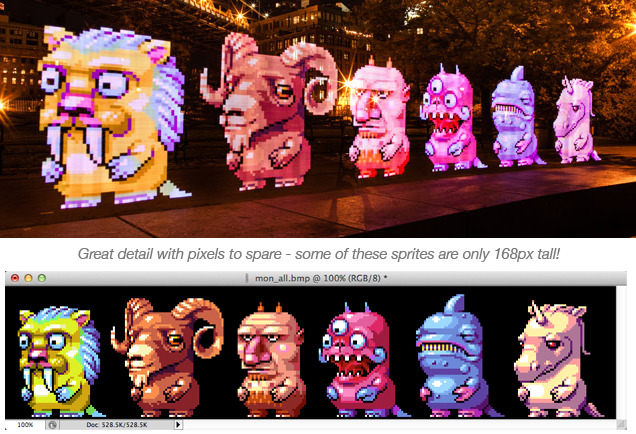
Pixelstick reads images created in Photoshop (or the image editor of your choice) and displays them one line at a time, creating endless possibilities for abstract and/or photorealistic art. Taking this one step further, Pixelstick can increment through a series of images over multiple exposures, opening up light painting to the world of timelapse, and allowing for animations the likes of which have never before seen.


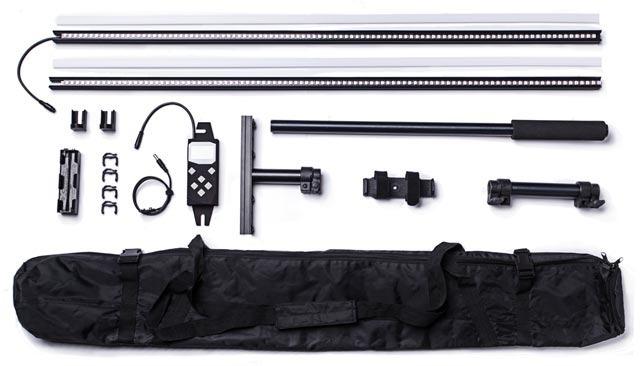
Pixelstick consists of 198 full color RGB LEDs inside a lightweight aluminum housing. Pixelstick’s brain, a small mounted box, reads images from an SD card and displays them, one line at a time. Each LED corresponds to a single pixel in the image. The images themselves can be from 1 to 198 pixels tall and many thousands of pixels wide. The handle is perpendicular and has a secondary aluminum sleeve, allowing pixelstick to spin freely. Pixelstick uses 8 AA batteries. Throughout testing we’ve used Sanyo Eneloop and Amazon rechargeable to great success, never requiring more than one set for a long night’s shooting.

What do we get?

A central bracket connects the two 3' sections of aluminum housing and provides a mounting point for the handle. Over many designs we found that the perpendicular handle allowed for the most natural movement for both linear striping and more organic, abstract movements. A rotating sleeve sits over the handle and can be locked tight when not in use, or loosened allowing Pixelstick to spin freely.

The handbox not only allows you to select which image to load, but controls brightness, tint, firing speed, vertical flip, and left/right direction. There is also a port compatible with remote camera triggers (Canon C1) for wireless shooting.

The entire unit is matte black, rendering it virtually invisible to long exposures. A mounting channel runs the full length of the back. This slot accepts 1/4-20" threaded bolts, standard to the camera world, and allows you to get creative by mounting things to Pixelstick and mounting Pixelstick to things.

Sturdy caps protect each end of the Pixelstick, while cable clips keep everything snug against the housing.


The full package contains:
  • LED PCBs (198 LEDs total)
  • Two 3’ aluminum extrusion with connecting bracket & diffusion lens
  • Handle with foam grip and rotating sleeve
  • Controller box with connecting cables and clips
  • Battery holder (AA Batteries not included)
  • Carry bag
The Tale of pixelstick

The Beginning
Pixelstick began as a proof of concept using an arduino and some off the shelf LED strips. We got results, but weren't happy with the resolution of nor with the durability and usability of the actual device. We moved quickly into custom LED circuit boards, a more powerful ARM microcontroller and a sturdier design made of lightweight aluminum rather than plastic tubing. With the ability to control the density of the LED count while at the same time refining the custom aluminum extrusion, the current version of pixelstick began to take shape.

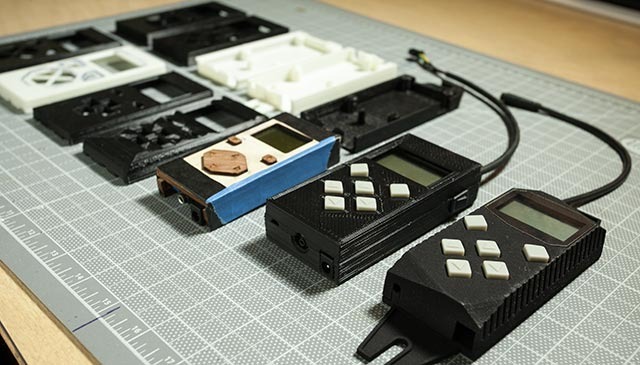
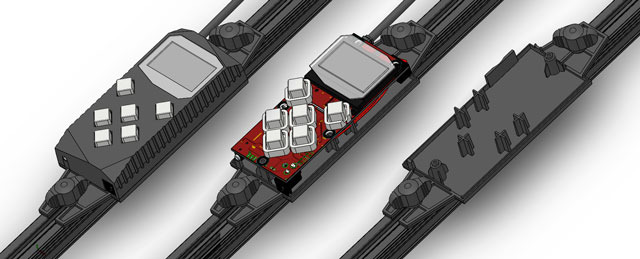
Our early controller prototypes were bare circuit boards, followed by a rather quaint wooden handbox (which we still quite like), and eventually on to higher and higher fidelity 3d printed enclosures. Each iteration performed better and was tweaked as we logged more hours with the pixelstick.
PCB Evolution

Just a few of the controller iterations
Controller Handbox and PCB
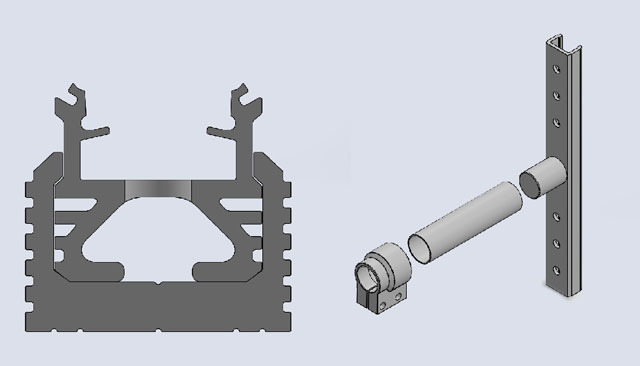
The handle went from a small stud, to a long vertical bar, and then eventually to a perpendicular tube with an attachment for spinning. We are still continuing to tweak the design as we move forward and have already committed to having a second extrusion made that will be more compatible with off the shelf nuts and bolts, so that replacements and extra hardware will be much easier for to source.
Extrusion profile next to Bracket/Stud
The MiddleWhen pixelstick is funded we'll be able to start production in earnest. Our circuit board will have its final stress testing and bug checking done before we lock in one of the multiple PCB manufacturers we have lined up. Once this is set we will have an initial small run of fully assembled PCBs made to test the vendor and make sure that no issues arise on the assembly line. Concurrently, we will do a final round of 3d prints of our handbox and revised extrusion design before moving forward with the tooling for the extrusion die and injection molds. Upon receipt of our new tooling we will do trial runs of both the extrusion and injection molded components. At this point we will have all the parts to make a fully assembled pixelstick as it will ship to our backers. It is here that we will do a final check to make sure everything comes together as expected and is up to our standards. When we are satisfied we will go into full manufacture on all components and begin producing and shipping pixelstick to our backers.
What's the money for?

It's surprisingly expensive to produce just one of something. Your pledge will help cover initial costs such as tooling for injection molding, and aluminum and plastic extrusions. Additionally, the cost of manufacturing only becomes feasible when we meet the minimum order requirements for our various vendors. This means that we must have a have a certain number of Pixelsticks spoken for before we can begin the process of manufacturing them.

We have a fully functional prototype, a design that we’ve refined over months of shooting, and multiple manufacturers lined up for every phase of the project. We need only the support of interested folks like you to put Pixelstick on the map and change light painting forever.
Rewards
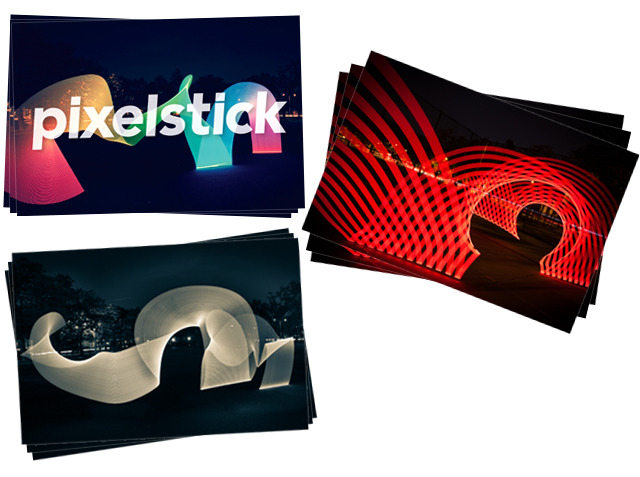
$10 - Pack of three 4 color, double sided postcards
$25 - 18x24 poster print
$300 ($250 for Early Birds!) - Pixelstick kit with Carry bag
Credits & Attributions

Music:
Pixelstick Montage music: Stormburner by Programs
Lightpainting Explained music: As You Want by Irregular

Artwork:

** Polaroid Pic - imustbedead Photography **
Graffiti - yeeerrrp on Reddit
Boombox - Paul Robertson (@probbz)
Scary Monsters - Cure

Various Lightpaintings:
Danimal1010 on Reddit
cal_mopho on Flickr
Crashburn on Wikimedia
Peter Thurgood on Wikimedia

The Pixelstick project will require managing several manufacturers and overseeing assembly of what these factories produce into a final product. Bitbanger Labs has experience dealing with these potential challenges from our previous project, Remee, which experienced some production delays because of components shortages and minor quality control issues. While this did cause a small delay in fulfillment, ultimately we are proud to say that we delivered a quality reward to all of our Kickstarter backers. To mitigate some of these potential risks, we have created relationships with multiple vendors prior to launch, so that we are able to react quickly should any problems arise during production of Pixelstick. While no production run is without its hiccups, we think our previous experience in not only managing a large project but also keeping our backers engaged and informed throughout the process equips us with all the tools necessary to bring Pixelstick to life.

FAQ

What size/format images should I use with Pixelstick?

Pixelstick images are 24-bit uncompressed .bmps, and should be 198 pixels high, which allows each LED to correspond to an individual pixel in the image. The images can be many thousands of pixels wide. Images that are more than 198 pixels in height are cropped by the stick when used but the file remains unaltered. For best results, we recommend resizing all larger images to the correct height, as well as experimenting with various resampling options to get the sharpest, most accurate resize.