Mostrando entradas con la etiqueta reciclaje. Mostrar todas las entradas

martes, 11 de marzo de 2014

D.O.R.T.H.E.

ORIGINAL: D.O.R.T.H.E.
from Lasse Munk


Meet D.O.R.T.H.E. She is currently 15”, pretty pale but an incredibly warm and caring max/msp patch, that creates music from your thoughts in the form of written words and sentences. She is amazingly well connected speaking several languages with which she controls a number of mechanical machines build almost entirely out of scrap electronics. She sometimes get surprised how much really well-functioning stuff gets thrown out every day, from several reasons - one being “the new model arrived”.

One visit to the junkyard provided her with roughly $300 worth of DC and stepper-engines, plus additional heaps of little useful things.

D.O.R.T.H.E. reuses words. She analyzes them, and use them for music creation because she believes that words, sentences and phonetics have many resemblances to music. Both one to one mappings like number of letters in a word translated to a pitch in music, but also emotional states like joy, distress, happiness, discomfort and fear.

D.O.R.T.H.E. is about re-cycling. Re-cycle words - turn them into music. Re-cycle electronics and turn them into instruments.

by lasse munk and søren andreasen

viernes, 12 de julio de 2013

Biomimicry: Mother Nature as a 3D Printer?

ORIGINAL: Triple Pundit
By Tamsin Woolley-Barker, Ph.D
July 11th, 2013
Last month, over 350 bio-inspired futurists from all over the world came together to ask how humans can learn from the rest of nature to create conditions conducive to Life. Not just sustainable economies, cities, and production systems, but a fundamentally new way of life that creates abundance, just as coral reefs and rainforests do. Welcome to the first Biomimicry 3.8 Global Conference, at the University of Massachusetts in Boston.

As I posted last week, the Conference’s opening day focused on “Generous Cities.“ These are urban environments that operate as regenerative ecosystems, actually improving the air, water, and land. On the Conference’s second day, that focus deepened and shifted away from buildings and cities, to the logistics of getting it done. “How would nature actually design the materials we need to build these cities?” Because, “at the end of the day,” said green chemist John C. Warner,we can only make products that are as sustainable as the building blocks we make them with.

We humans tend to solve each problem by creating a new polymer or plastic, none of which co-evolved with creatures to eat them. The result is that our “solutions” end up littering the Earth in perpetuity. Alternately, with all the cheap fossilized carbon lying around for us, it’s easy to apply energy to the problem: just plug it in and power it up! Unfortunately, burning yesterday’s carbon is changing the chemistry of our atmosphere faster than its inhabitants can adapt to it.

How would nature manufacture it?
Contrast our “plug-in/plastic” approach with that of our fellow Earthlings. Not having figured out how to eat fossils, they are on a pretty tight budget. They can only burn what they eat, and they have to make solutions from their own bodies or things they find around them. This leads to low-cost, highly-efficient structural solutions that use a handful of polymers, respond to the environment in adaptive ways, and can be broken down and reused by other creatures. This kind of problem-solving results in the highly interconnected and incredibly rich web of collaborative interdependence we call Life.

The flaccid sea cucumber, for instance, instantly goes rigid as a kevlar jacket, simply by changing the orientation of tiny cellulose “whiskers” in its gelatinous tissues. Likewise, tiny pores on the leaves of plants open up gracefully, breathing carbon dioxide for photosynthesis, then clamp shut minutes later to conserve precious water. The action is passive, triggered by changes in light, carbon dioxide concentrations, and water availability.
Learn from the ostrich egg  
Tom McKeag, editor of the beautifully-designed and award-winning bio-inspired digital magazine, Green Chemistry, set the stage for the idea of “regenerative manufacturing.” In a thought-provoking workshop called “Learning from the Ostrich Egg,” he presented the participants with a huge but humble marvel of engineering and clean design. What can our designers, material scientists, and architects learn from the egg? McKeag described its contradictory functional requirements. The egg must be strong enough to survive a precipitous drop from a very tall bird, then break apart for the tiny chick to hatch. It must be easily turned by the parent, but not roll away. Waste gases escape, but nourishing fluids remain. All these things and more are accomplished, using very few materials, all locally sourced and recyclable. The egg’s contradictory specifications, said McKeag, are what drive innovation and exquisitely efficient design.

3D printing revolution

The highlight of the day was a riveting presentation by MIT Media Lab Director Neri Oxman. Named one of Fast Company’s 100 Most Creative People, Oxman’s talk captivated the audience. She is at the forefront of the 3D printing revolution, looking to create synthetic “smart” materials that act as natural ones do. In nature, said Oxman, bones thicken in response to force, leaves grow toward light, and trees branches are shaped by wind. Why not a wrist splint that adapts to where you feel pain? Why not a lounge chair that shapes to your body and adjusts to your weight? With 3D printing, these possibilities become real.

A quick glance at an industrial manufacturing catalog will tell you that engineers like to assemble bits and parts. But that’s not how nature builds. Instead, living systems use a stripped-down palette of self-assembling materials that act in dramatically different ways with simple structural changes at the nano-, micro-, or macro level. The soft skin on your face, for instance, is not the same as the nasty stuff on the soles of your feet. An antelope’s hair, hooves, and horns are all made of keratin, but each does a quite different thing. We can do this with our materials too. What about printing with fiber optics to produce light-emitting objects? Or making a pair of glasses as a single piece that varies in transparency, rather than a separate frame and lenses?

But, said Oxman, our 3D printing technology has limitations. First, our feedstock is primarily non-structural plastic resin. Does it have to be? Not at all. The material can be whatever we decide it is as a society. Second, the size of the printing “frame” or gantry currently limits the size of the object. But what if we could scan and print freeform, using drones or robot arms? Third, current printers accrete horizontal layers, but living tissues build themselves organically, in three dimensions. How can we transcend our technology? Oxman’s team at MIT’s Mediated Matter set out to circumvent these limitations by developing the first freeform 3D printer, playing with different materials, and doing extensive digital consideration of desired objects. The result is a truly remarkable artistic vision of a not-so-distant, but radically transformative, future of “Making.”
Silk Pavilion

But as tantalizing as their findings were, Oxman said, the team remained frustrated by their primitive tools. Suddenly, she said, they hit on domesticated silkworms as living 3D printers, and the question became, “How would nature design a 3D printer?” They studied the “simple rules” used by silkworms in determining where and how to lay down silk, built a Buckminster Fuller-inspired geodesic dome scaffolding to elicit the desired responses, and released 6500 Bombina moryx silkworms. The worms “printed” the beautiful Silk Pavilion now hanging in the MIT Media Lab lobby, with “smart” variations in density and patchiness responding to light and substrate, consciously elicited by the team. In essence, the silkworm is a combined biocomputer and freeform printer, programmed by its DNA, printing with a biodegradable (and lovely) material, produced on-site simply by feeding the silkworms.

When asked what the future holds, Oxman lit up. She suggested that we could print objects perfectly designed by the requirements of a space itself. We could print with carbon nanotubules, effectively making a 4D printer that produces objects that adapt over time. This material would be “alive,” responding to light, heat, force, or humidity to create “smart” objects that adjust automatically to their environment. Or, she suggested, we could print large structures, like homes and bridges, using variable-density concrete to provide extra strength where it is needed and conserve material where it is not. She floated the possibility of changing the “printing material” or the “simple rules” of production through genetic engineering (like having silkworms print with spiderweb), or using other “living printers” like spiders, mushroom mycelium, vines, or corals. Could we cultivate self-assembling underwater structures from CO2, just as corals do today? The printers of the future could be robots inspired by these organisms, or something else entirely: a living scanner, printer, and biocomputer. Imagine “growing” your home, lighting, and furniture from “genetic blueprints” downloaded off the internet into a robot or a made-to-order living entity?

This vision elicited a predictably polarizing response from the audience. Many were horrified by the hubris of genetically engineering living creatures to act as our slaves. Biomimicry 3.8 Co-Founder Janine Benyus expressed this sentiment, standing up to say that biomimicry hopes to look beyond using organisms as raw resources, to a deep “process of learning from other fabricators. If you’re wearing cotton, a plant made it for you. If you’re wearing wool, a sheep made it for you. It’s time for humans to start making our own materials.

3D printing represents a transformative opportunity for us to redesign our manufacturing and consumption patterns, she said, pointing out that a great many of our machine parts are used to cut or grind away, literally subtracting, discarding, and wasting our planet’s precious resources. 3D printing, by contrast, is an additive process, using only what is needed. The time is coming, Benyus said, when we will “Make” everything we need at our neighborhood “Maker Shop,” exactly what, when, and where we need it, without waste or energy-intensive shipping. “But,” she added, “let’s make sure these printers aren’t tiny volcanoes on our desks,” dropping humanity out of the frying pan and into the fire. She implored the audience to make sure that locally abundant and benign feedstocks (ideally from the excess carbon dioxide in our atmosphere and oceans) become standard, materials that can be enzymatically digested at the end of product-life and fed back into our printers. Just like Nature would do it.

Dr. Tamsin Woolley-Barker is an evolutionary biologist, writer, and Biomimicry 3.8-trained sustainability and biomimicry consultant. She blogs at BioInspired Ink and serves as Content Developer for the California Association of Museums’ Green Museums Initiative. She is working on a book about organizational transformation and resilience inspired by living systems.

[image credits: Kevin Krejci, Nasturtium Leaf, Ed Bierman, Sea Cucumber, Colin Raney, Silk Pavilion at MIT]

domingo, 14 de agosto de 2011

Protesta Artística Ecológica en España

ORIGINAL: Luz Interruptus

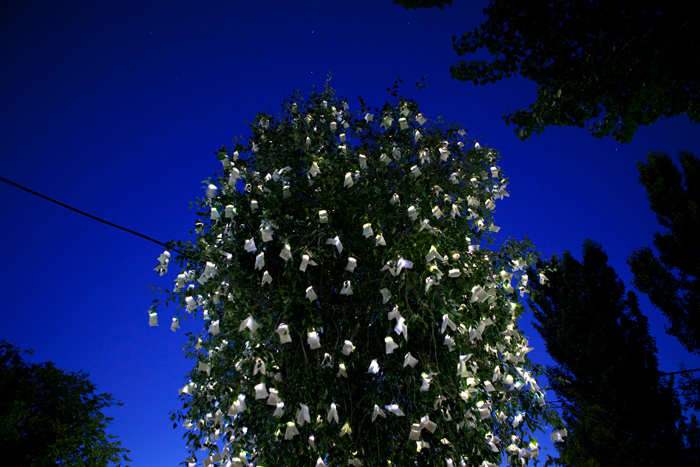
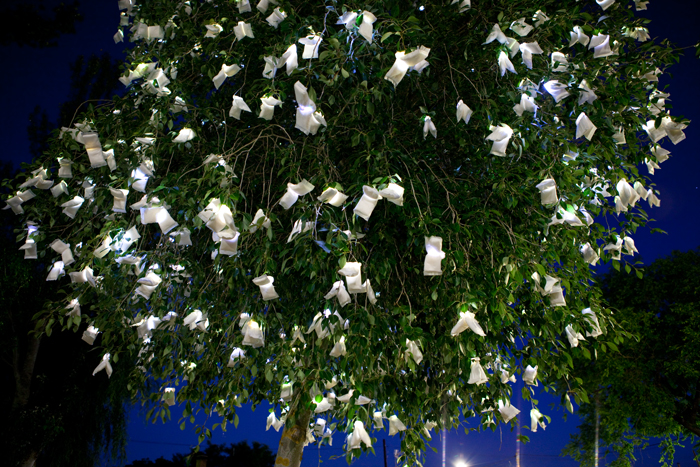
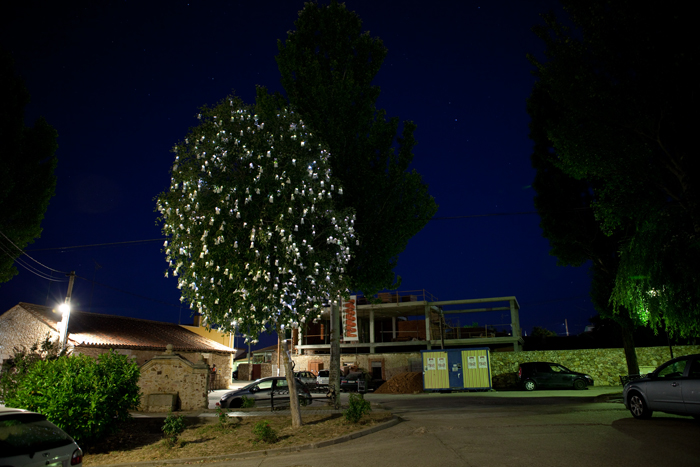
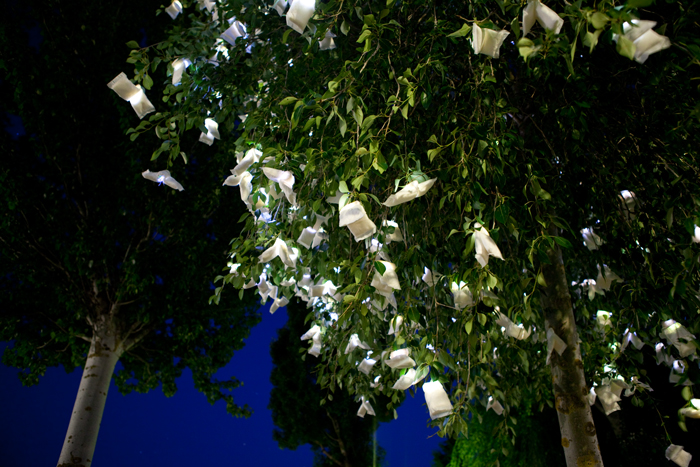
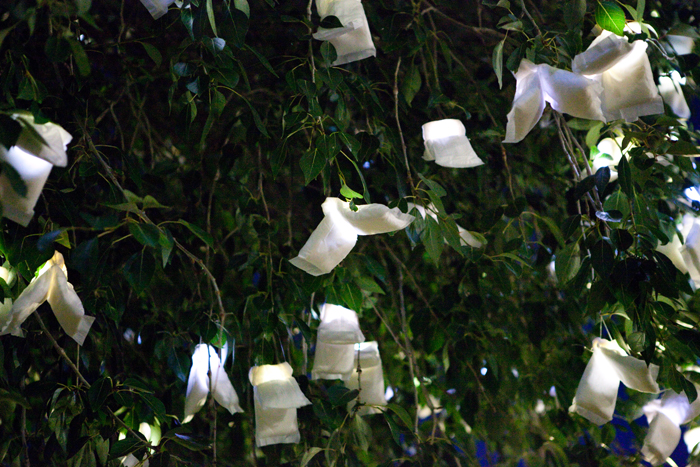
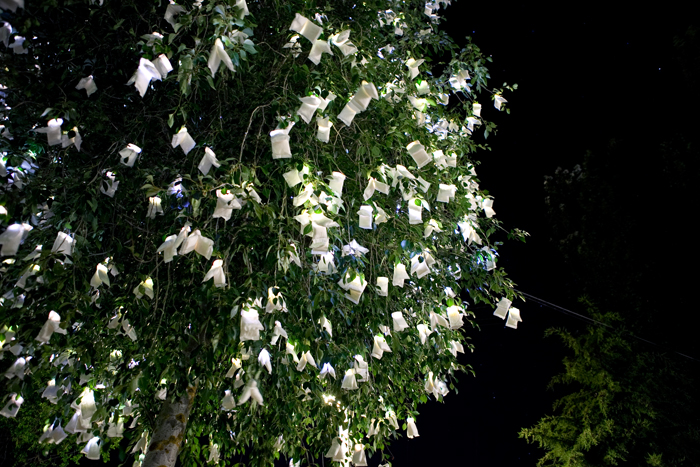
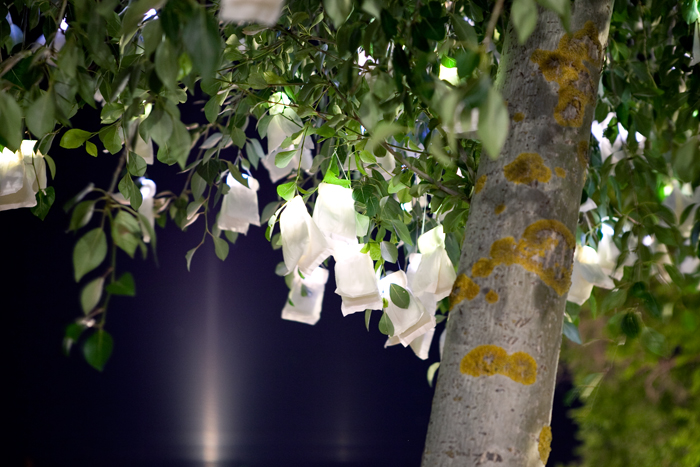
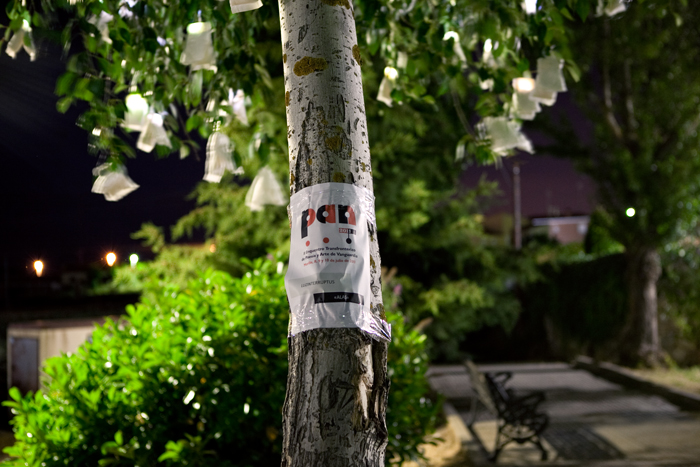
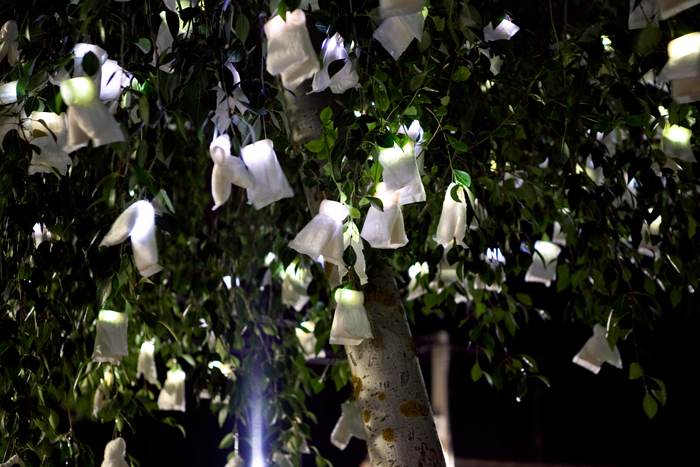
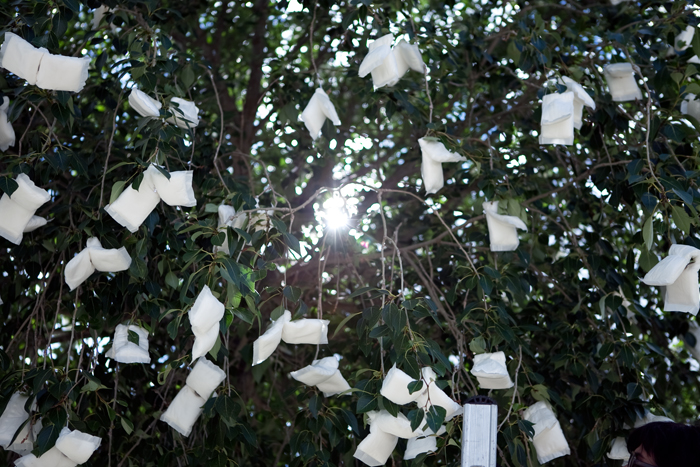
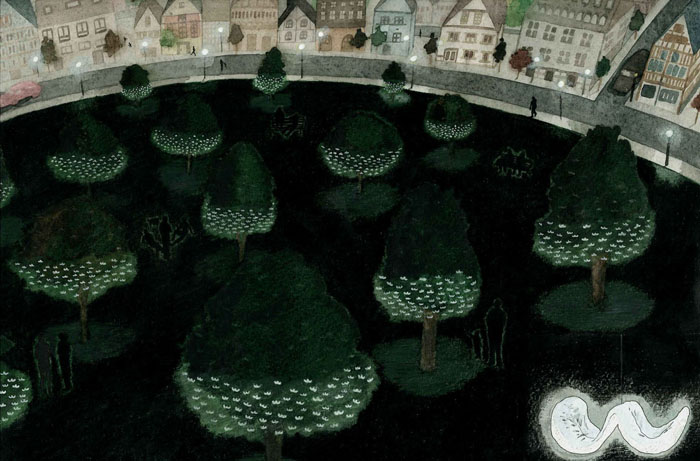
Arbol alado / Winged tree

Es enojoso observar cómo la publicidad cambia el aspecto de los objetos que pone a la venta, para adaptarlas a sus intereses y para que nosotros, al verlos desde su perspectiva, sintamos inmediatas ganas de consumir lo que nos ofrecen.

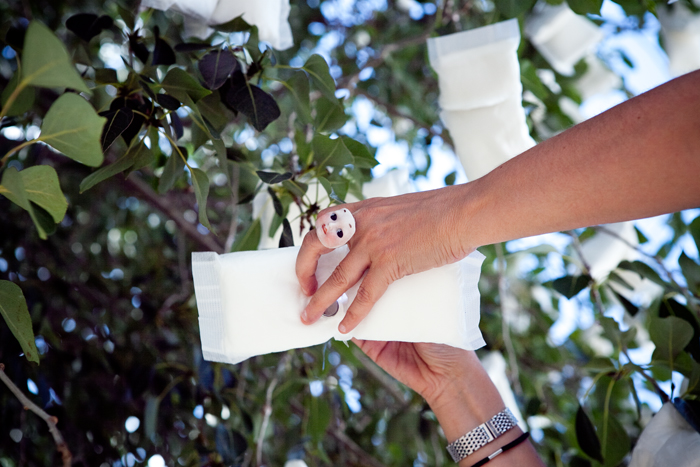
Este es el caso de por ejemplo las compresas, que normalmente se anuncian como productos etéreo, ligeros, blancos inmaculados, sin olor, estéticamente bellos… evitando que aparezca el color rojo, más real, que es sustituido por sutiles toques azules, que son dejados caer sobre la superficie blanca, como si de lluvia se tratase.

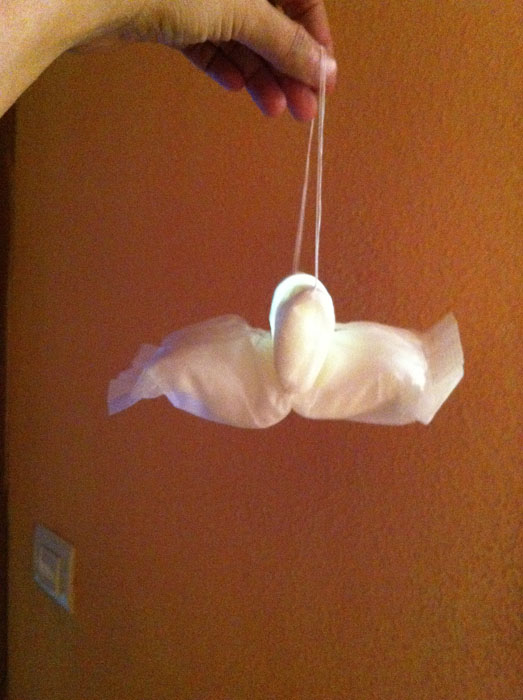
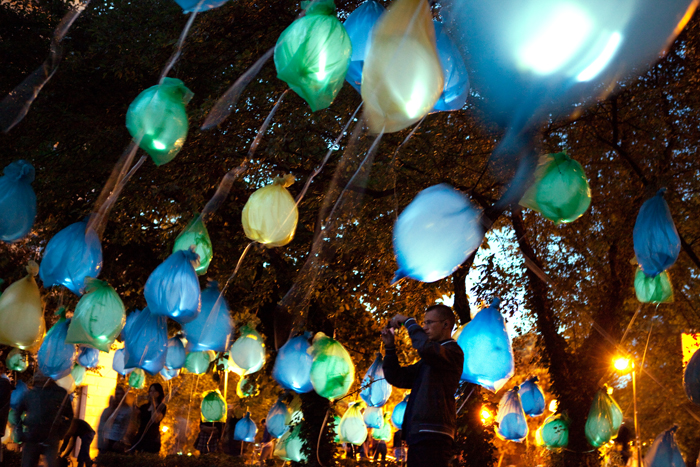
El eslogan de una antigua campaña publicitaria de compresas, “Ausonia te da alas” en el que las chicas aparecían flotando felices, los días en los que usaban este producto, nos inspiró para nuestra propuesta Alas de celulosa, en las que por una vez nos hemos creído la publicidad y hemos convertido un objeto de tan engorroso uso, en otro mucho más onírico, puro y delicado.

Las fotos son de Gustavo Sanabria. La ilustración de Marta Menacho. para Luminale 2010.
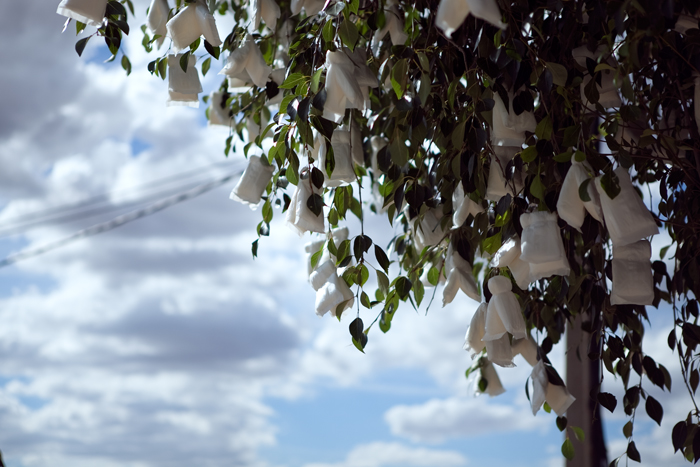
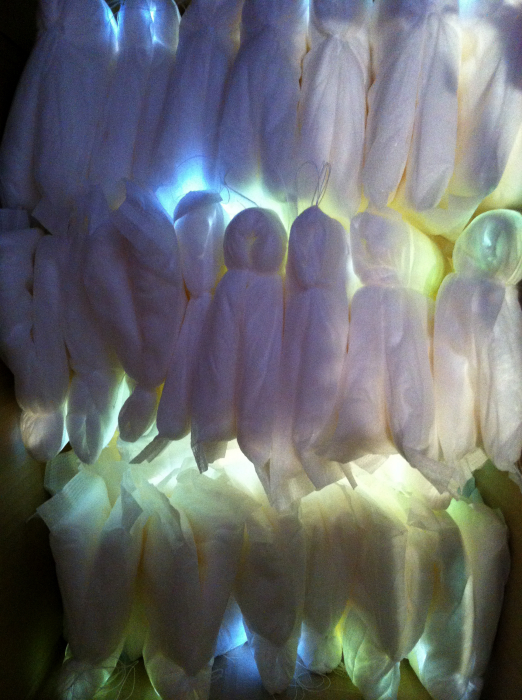
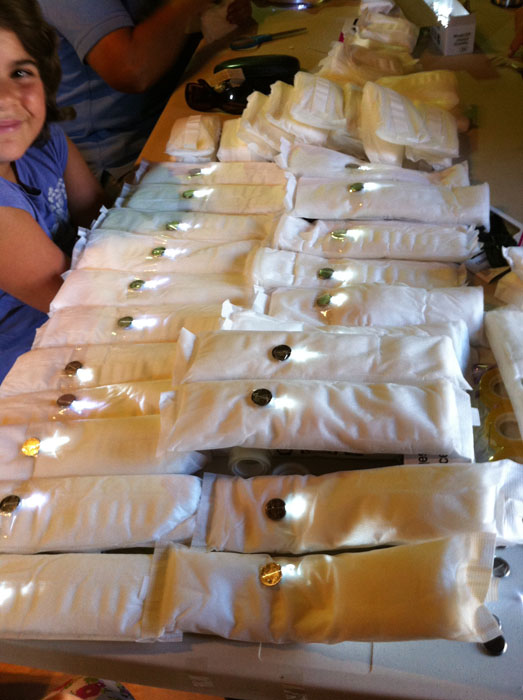
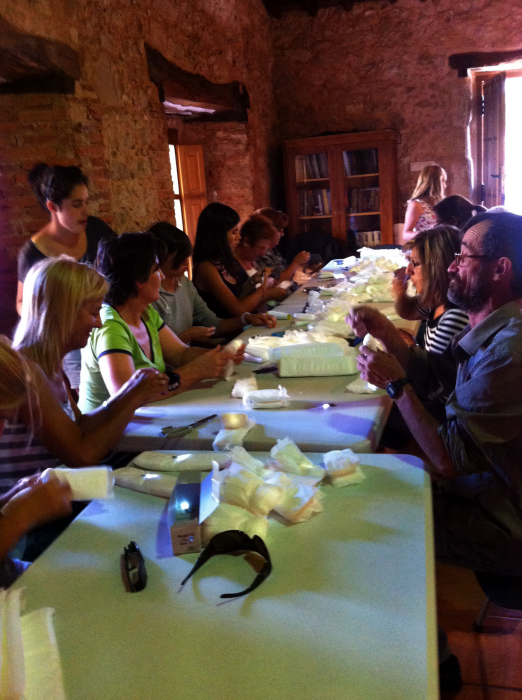
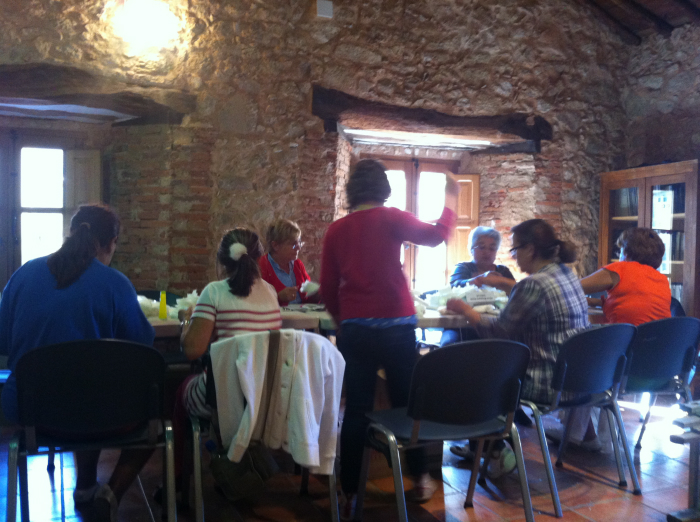
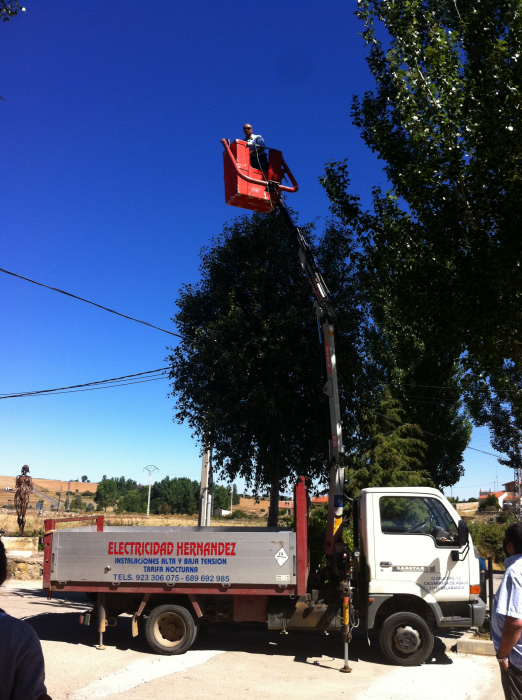
Finalmente la instalación fue llevada a cabo en Morille (Salamanca) durante el Festival Pan. Para ello utilizamos 1.000 compresas, que convertimos en blancos pájaros iluminados y colocamos en un gran arbol de la Plaza Mayor.
Gracias a Fabio de la Flor por invitarnos y a los amigos de Morilles por acogernos y ayudándonos animosamente en la elaboración de la pieza y en el montaje. Fue un placer compartir días con todos.
Tiempo de montaje: 3 dias.
Daños ocasionados: 0.

Permanencia de la intervención: 7 días
———————————————————————–

It is bothersome to see how advertising campaigns change the appearance of things so as to adapt them to their own interests, and by seeing from this point of view we feel inclined to buying the products or services advertised.

It is the case of sanitary towels, for instance, which are advertised as ethereal, light, inmaculate, odorless and beautiful. But the red colour is never present and it is replaced by blue drops that fall as if it were rain on them.

The slogan for the advertising campaign of sanitary towels called “Ausonia makes you feel free” (Ausonia te da alas) shows young women floating merrily in the air and the days on which they must use this item. It became an inspiration for our proposal Cellulose wings and for just this time we have believed the message and we have turned this object –so annoying to use- into a much more oneiric, pure and delicate.

The photos are by Gustavo SanabriaIllustration by Marta Menacho for Luminale 2010.

The installation was definitly carried out in Morille (Salamanca) during the Pan Festival. For this, we use 1000 sanitary towels, which became bright white birds, and placed in a large tree in the main square.
Thanks to Fabio de la Flor for inviting us and friends of Morille for hosting and helping to carry this out. It was a pleasure to share days with them.
Time of installation: 3 days.
Damages: none.
Exhibition time: 12 hours.

Archivado en efímerofestivaliluminación |

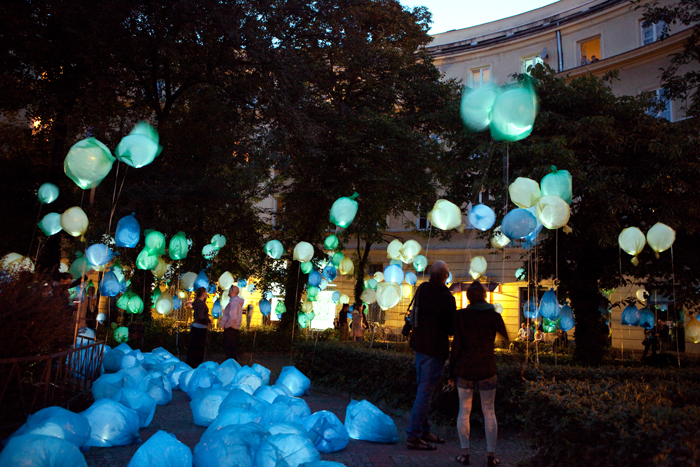
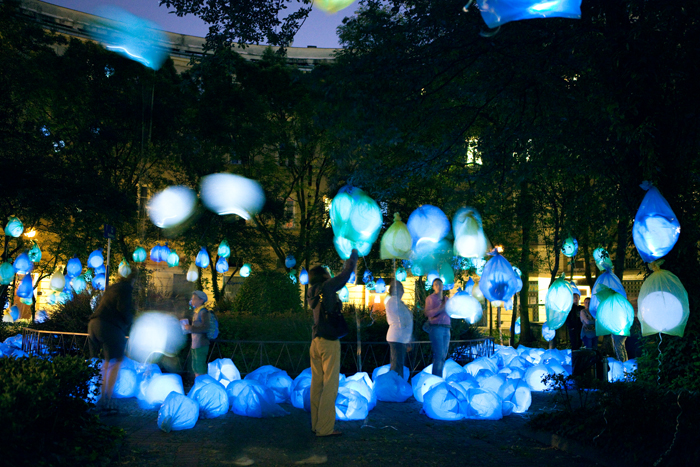
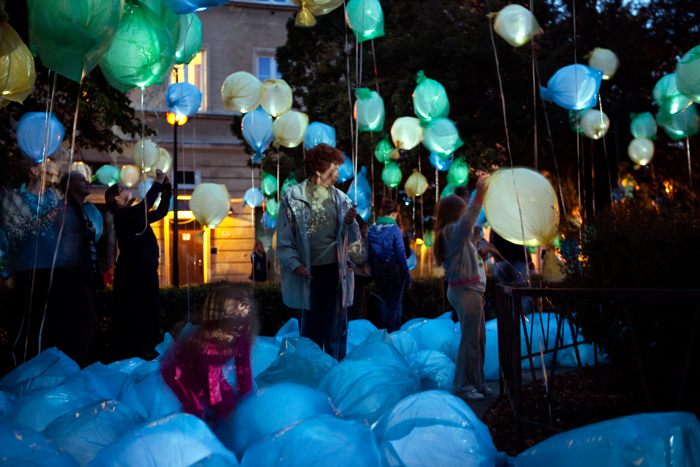
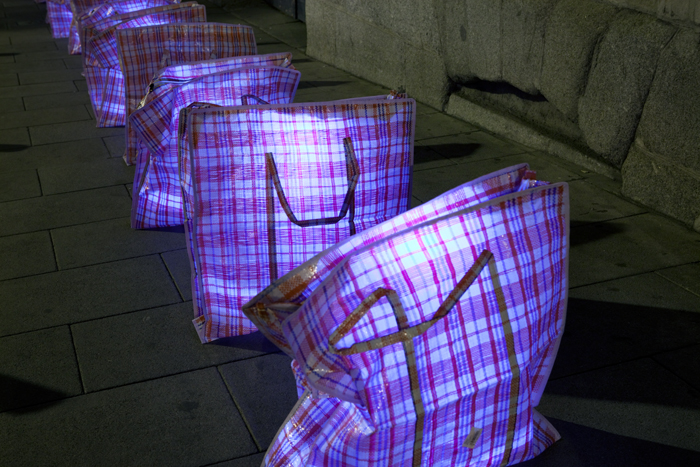
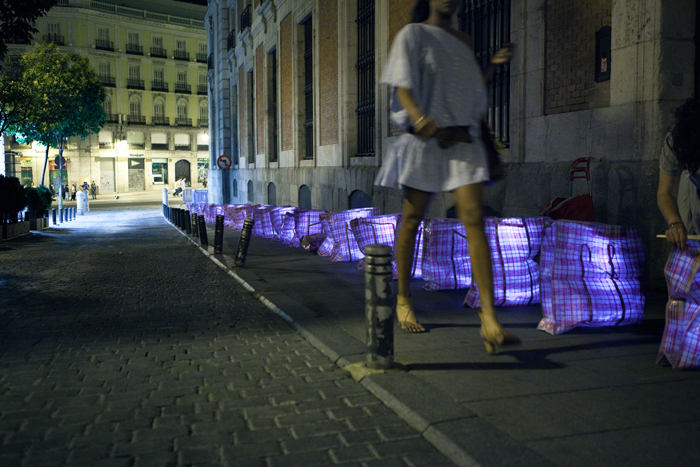
Aproximación al reciclaje / Bringing recycling closer

Archivado en basuraefímeroiluminaciónintervención |

Despedida en Sol y retorno a casa / Farewell to Sol and the return home

Fauna y flora preservada / Fauna and flora preserved

Archivado en efímeroguerrillailuminaciónintervenciónverde |

Reciclaje electoral/Electoral recycling

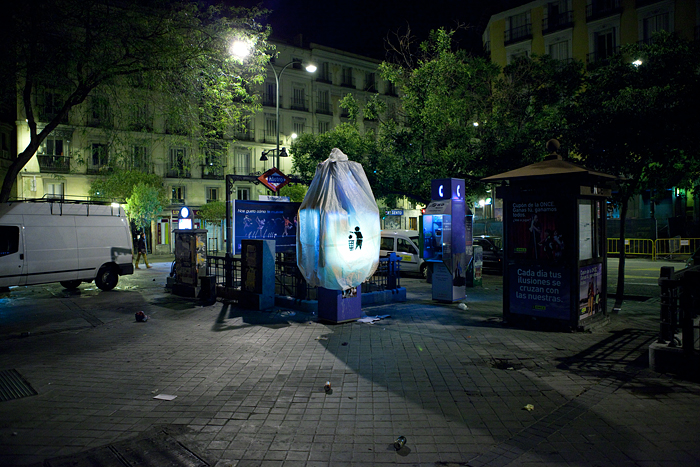
Enter titleTanto desprecio y hastío nos ha producido la campaña electoral, que hemos decidido mandarla a la basura.

Esto pasó el jueves previo a las elecciones municipales y autonómicas españolas, en un momento crucial para nuestra democracia en la que todos los “descontentos” hemos salido a la calle a expresar, de manera pacífica, nuestras opiniones sobre una clase política, que nos ha llevado a esta crisis feroz a la que no somos capaces de ver el fin.

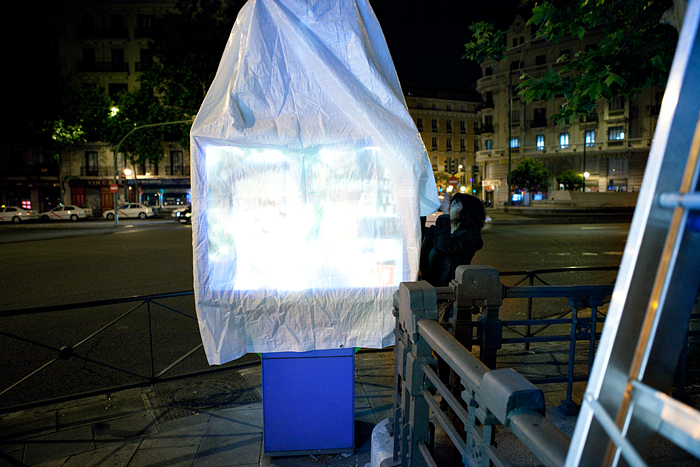
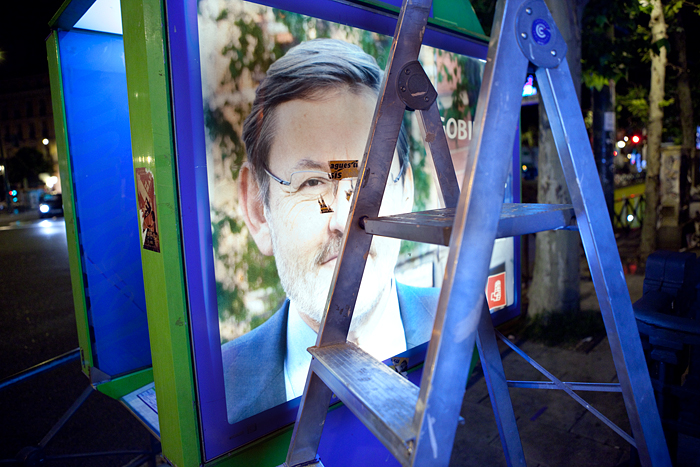
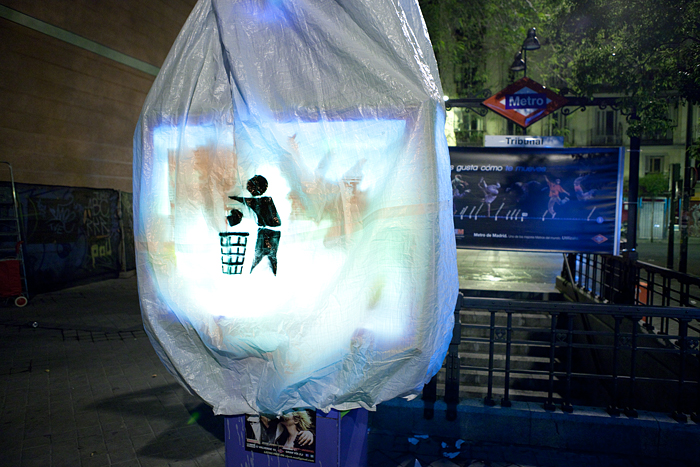
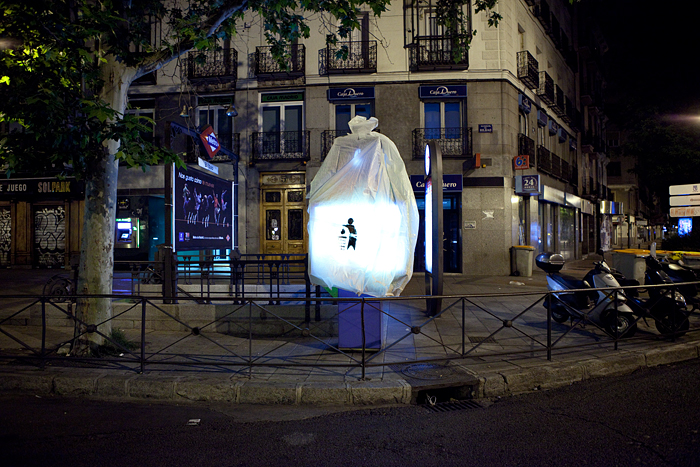
Para nuestra acción Por favor, reciclen su basura, elegimos uno de los soportes publicitarios más utilizados por los partidos políticos, las cabinas de teléfono, las metimos en grandes bolsas de basura y las dejamos listas para el reciclaje, con políticos dentro.

Intervinimos varias, en la zona centro de la ciudad, intentamos no centrarnos en ningún partido, pero “curiosamente” casi todas las que encontramos, estaban ocupadas por los que ahora gobiernan.
Las fotos son de Gustavo Sanabria.
Tiempo de montaje en la calle: 5 horas.
Daños ocasionados: 0.

Permanencia de la intervención: + de 24 horas.
————————————————————————————-
So much disgust and contempt has been produced by the electoral campaign that we have decided to put in the trash.

This happened the Thursday prior to the Spanish municipal and regional elections, at a crucial time for our democracy in which all the “unhappy” people took to the streets to express, in a peaceful manner, our views on a class of  politics which has led us to this vicious crisis which we cannot see the end of.

For our action Please, recycle your garbage, we chose one of the advertising medias most used by the political parties, telephone booths, which we put into large garbage bags and left them ready for recycling, with the politicians inside.

We performed various interventions, in the center of the city, we tried not to focus on any party, but “curiously” almost all the ones we found, were occupied by the party which now governs.
The photos, as always, are by Gustavo Sanabria.
Time of installation in the street: 5 hours.
Damages: none.
Exhibition time: more than 24 hours.
Archivado en basuraefímerointervenciónpublicidad |