Mostrando entradas con la etiqueta GRUPO MENTE NÓMADA. Mostrar todas las entradas

lunes, 13 de enero de 2014

Andy Lomas Lets Digital Systems Bloom In "Morphogenetic Creations" Exhibit

By DJ Pangburn
Jan 10 2014

Andy Lomas, a digital artist and mathematician, likes to let the virtual world spin out of control. Using software code to creates very basic rules, Lomas then sits back and watches his digital “growth systems” bloom, fractalize, shape-shift, and otherwise behave in organic and emergent ways.

Yesterday, at the Los Angeles Center for Digital Arts (LACDA), Lomas’s Morphogenetic Creations opened, giving digital art enthusiasts the opportunity to see his dynamic virtual systems up close. The exhibit includes work from the Aggregation, Flow, and Cellular Forms series. To coincide with the exhibit, Lomas uploaded a view of these digital growth videos to Vimeo. Startlingly beautiful to behold, they’re a bit like Ernst Haeckel’s Art Forms of Nature animated with a cyberpunk edge.


I recently rang up Lomas, who lives in the United Kingdom, to talk about Morphogenetic Creations. We talked about his background in mathematics, his early fascination with D’Arcy Wentworth Thompson’s On Growth and Form, and how his work as a computer-generated effects artist for film (The Matrix sequels and Avatar), where highly-predictable outcomes and stability predominate, served as a springboard for the more random digital forms he now creates.

The Creators Project: What can people expect to see at the Morphogenetic Creations exhibit at LACDA?

Andy Lomas: There will be four animation pieces from the Cellular Forms series in the windows, but also then some 44x44-inch big prints of new and old work. They’re ridiculously high-resolution at 12,000x12,000 pixels.


Another thing I have at LACDA for the Aggregation series are picture frames with these old, Victorian-style stereo viewers to create a 3D effect. The frame only contains two pictures, but through the stereo viewer it really looks like this three-dimensional thing. I believe they’re going to pull those out for this exhibit as well.

Is Cellular Forms the most recent series?

The two Cellular Forms videos are the most recent. They’re almost exactly the same date because they’re basically differently rendered versions of the same thing. That would be Cellular Forms and Cellular Forms (X-Ray version).


What I quite like is the idea that there are two things: the creation of these three-dimensional data structures, where the goal is to create the most organic things possible with very simple rules; and that there is no one correct way of doing that. One shows you everything solid, while the other gives you an x-ray that reveals what’s actually going on inside. Neither is the original, if you like. They’re just different views into the data.

And you wrote the software code for this series?
Yeah, I wrote the software for Cellular Forms. I’m a code junky. I write it for my own pleasure. There are two main parts to the code. 
  • One is what I call the simulation engine, which is the thing that is actually almost like running a growth process. It starts with a sphere or ball of cells, with rules for how they divide and have forces between them, how it moves, changes shape, and grows over time.  
  • Then there is the rendering stage, which takes the data produced by that simulation and turns it into something you can see. It produces pixel data out of cell data, if you like.

Did you use this code in your film work, or did you build it on the side for this specific purpose?
It’s completely built on the side. It’s very much a labor of love. When I worked on The Matrix sequels for this company I was working with then, another person there used a much simpler version of what’s called Diffusion Limited Aggregation for some of the effects work. It was used for when Agent Smith was turning other people into other Smith’s with these tendril things. DLA inspired the code I wrote.

When you’re doing things for films, you have to construct things in a very different way—you have to make things very controllable and directable. Whatever you do, when the director or visual effects supervisor looks at it and says, “That’s great, but can you change this and modify that,” that is what you spend most of your time doing. One of the things I like about my own work is that it is trying to be almost exactly the opposite. You’re hoping for the things which are unexpected.


It’s almost like growing plants; you don’t know exactly how a plant is going to grow. But, you start to learn that if you cross-breed that with that, then it might do something interesting. Maybe nine of the plants end up really uninteresting, but one does something really interesting and maybe different than what you thought it would. People talk about emergence, where things emerge that you didn’t expect, which you almost can’t use in professional production.

Do you prefer the lack of control that your solo work affords you?
I’ve got to say that I prefer the lack of control. As soon as things become digital, people think that they can control everything. When you get to a certain level of complexity, you can explore it more than control it. I prefer the things where 99% of the time it doesn’t produce anything interesting, but that 1% of the time is like, “Wow, that’s really cool.” I’m not a control freak director. I actually want the work to surprise me instead of do exactly what I thought it was going to do.


What specifically might have influenced Cellular Forms and your other series?
I’ve always been fascinated by sculpture and form. I also used to scuba dive and look at coral. To my mind, organic things go from really hideous to incredibly beautiful, whereas most engineered things go from ugly to something quite interesting. In organic forms, there is a very visceral reaction. Trees look beautiful and mold looks ugly, and things like that.


My original background is in mathematics, which I studied as an undergraduate. One of the main areas I got interested in is what’s called Dynamical Systems, which is sort of the math behind Chaos Theory and Complexity Theory—the math of how things change over time when you almost reapply the same rule again and again and again. So, the combination of those two, it’s almost like how simple could the rules be to make something that is as beautiful as a tree or coral or something like that. So, those two have always been like two germs working together. And, to my mind, computers are the things that allow you to actually try that out.


Any other critical influences in your work?
There was a Scottish mathematician named D’Arcy Wenthworth Thompson, who wrote a book about a hundred years ago now called On Growth and Form, which is basically him talking about the constraints of the real world. When you think about how things grow, are the sorts of forms that you see in the real world just the results of almost the only things that can grow? With a computer we can actually test that. Often, it doesn’t work quite how you expected.

For more of Lomas' work, head over to his website here.

@djpangburn

domingo, 29 de diciembre de 2013

Gorgeous Computer-Generated Flowers Bloom: Photos


British philosopher and mathematician Bertrand Russell once said, "Mathematics, rightly viewed, possesses not only truth, but supreme beauty." One look at these computer-generated images from Daniel Brown and Russell's words come to life.

Brown, a London-based designer, programmer and artist who specializes in digital technology and interactive design uses custom algorithms to "grow" gorgeous floral artwork that will blow your mind. Here are 11 of our favorites.
Courtesy Daniel Brown


It all started in 1999, when Brown demonstrated a computer program and mathematical model that used special code to produce fractals. The resulting animations were almost hypnotic. "It was the first time I realized that non-technical people could aesthetically appreciate mathematical formulas if they saw them 'come alive,'" he said.
Courtesy Daniel Brown


Brown created the pieces in this slideshow for the Victoria and Albert Museum and the D'Arcy Thompson Zoology Museum, as well as projects for corporate clients. A swimming accident in 2003 broke Brown's spinal cord, causing paralysis. As a result, he uses a finger-splint device and a large track pad to operate a computer. Even without this added challenge, his flowers are uniquely beautiful; no two look exactly the same.
Courtesy Daniel Brown


Several years ago Brown produced a three-story-high projection of flowers for the Victoria and Albert Museum. Each petal generated contained combinations of images from the museum's textile collection. The work was named in honor of D'Arcy Wentworth Thompson, a pioneering bio-mathematician known for his 1917 book On Growth and Form.
Courtesy Daniel Brown


Last year, the D'Arcy Thompson Zoology Museum at the University of Dundee in Scotland contacted Brown after seeing his Victoria and Albert Museum work and asked him to create a piece for them. Brown said he used generative design to create the realistic flowers for this newer exhibition, which went up last spring. Each flower shape is determined by an algorithm that is then altered to take into account natural variation.
Courtesy Daniel Brown


Another mathematical formula is used to generate the color and texture applied to the shapes. Each arrangement is grown over about 50 seconds, resembling time-lapse photography that's been sped up. "After this, they fade out and another arrangement is created," he said.
Courtesy Daniel Brown


Brown's original pieces only used two-dimensional computer graphics that mimicked a 3-D look. However, in the past few years, computer technology has evolved so that he can simulate surfaces, behaviors and lighting in real time.

Sometimes Brown produces a flower that even amazes him. "I can't work out the particular parameters that would have gone into it, and am left scratching my head," he said. "Because the flowers regenerate every minute or so, it's a fleeting moment, and there is something almost poetic knowing that no one will ever see that one flower again."
Courtesy Daniel Brown


D'Arcy Wentworth Thompson was a Scottish scientist and scholar who took various natural processes such as evolution and tried to question them mathematically. He sought to discover out how differences in shape and form between two genetically related species could be mathematically modeled, Brown explained.

He also wondered about physical processes like weather, and how they could change one shape into another. Getting contacted by the D'Arcy Thompson Zoology Museum was the ultimate honor, Brown said. "I couldn't think of a more fitting thing to do for one of my scientific heroes."
Courtesy Daniel Brown


Brown's flowers are so realistic that occasionally museum visitors won't realize they're computer graphics and will insist on asking him what kind of flowers they are. Other reactions are more visceral.

"When my work was on show in the Victoria and Albert Museum, young children -- toddlers rather -- would run up to the wall it was being projected on and try and hug it," he said. "At that moment people stop seeing technology, and just see beauty."
Courtesy Daniel Brown


While he's staying quiet about plans for future art projects, Brown said he looks forward to a future when 3-D printing is refined enough to print realistic versions of his computer flowers.

Courtesy Daniel Brown


He imagines he'll be able to make ever more intricate and extraordinary flowers. "Although I was both an artist and programmer before my injury, I have switched to creating art purely with code," Brown said. "In that way I consider myself incredibly lucky. I think I had one of the only jobs in the world that could 'survive' such a life changing event as that."

To see more images, visit Daniel Brown's Flickr page.
Courtesy Daniel Brown


ORIGINAL: Discovery
by Alyssa Danigelis
Nov 21, 2013

sábado, 28 de julio de 2012

Making Giant Graffiti With Lasers


Stuck somewhere between an artist and an engineer, James Powderly has created some of the most unique and imaginative technologies used in street art in the past couple years. Find out how he went from working at NASA to working with street artists.

Discover more about James Powderly here: http://bit.ly/dpFwKj

The Creators Project is a partnership between Intel and VICE: http://thecreatorsproject.com/
**
Subscribe to The Creators Project:http://bit.ly/Subscribe_to_TheCreatorsProject

Like The Creators Project on Facebook: http://fb.com/thecreatorsproject
Follow The Creators Project on Twitter: http://twitter.com/creatorsproject

lunes, 2 de julio de 2012

Woodcut: A Meditation on Time Through the Inked Cross-Sections of Fallen Trees

ORIGINAL: Brain Pickings

Bryan Nash Gill’s visual record of the passage of time.

Trees have a way of witnessing the world that stirs our deepest sense of permanence and impermanence . Somewhere between Cedric Pollet’s Bark and Romeyn Houghs’s cross-section plates comes Bryan Nash Gill’ s Woodcut ( public library ) — a magnificent collection of the artist’s large-scale relief prints from the cross-sections of fallen and damaged trees.

Gills’ ink prints — sometimes stark, sometimes nuanced, always exquisitely beautiful — provide another, at once more abstract and more organic, way to visualize time , his labor-intensive printmaking process mirroring the patience imprinted on the trees’ arboreal rings. Looking at the cross-sections from above, inverting one’s usual orientation relative to a tree, kindles a kind of transcendental awe at these radial life records.

Ash, 2003. 82 years printed

Red Ash, 2007. 82 years printed
Double Crescent, 2009. Norway spruce. 45 years printed
Black Locust with Bark, 2009.  87 years printed
Honey Locust, 2010. 31 years printed
Eastern Red Cedar, 2011. 77 years printed
Glue Lam, 2003
One of Gill's first prints created from dimensional lumber. Glued laminated timber is known for its superior structural strength and used in columns and beams. This print, revealing the grain patterns of glued lumber, is made from two boards stacked and rotated.

Gill at work, inking the block and printing (pressing the rings) of Eastern Red Cedar

Nature writer Verlyn Klinkenborg observes in the foreword:

Something [happens] as you peer into these boles. They confound time, simultaneously offering diachrony and synchrony, to use those nearly antiquated words. You look across all of the tree’s living years, exposed at one. And yet, as you move from the center to the periphery — to the final present of that individual tree — you’re also looking alongtime, along the succession of growth cycles that end in what is, after all, the death mask of a plant, the sustained rigor mortis of a maple, ash, spruce, locust, and other species.


Woodcut

Beautiful and quietly poetic, Woodcut is an absolute treat both aesthetically and conceptually, pulling you into a deeper contemplation of the passage of time as it sweeps you up in a meditation on beauty.

Captioned images courtesy of Princeton Architectural Press / Bryan Nash Gill

sábado, 7 de abril de 2012

Un estudio genético sugiere que los girasoles de Van Gogh eran mutantes(FOTOS)

ORIGINAL: Huffington Post
Por Ferris Jabr
03/30/2012

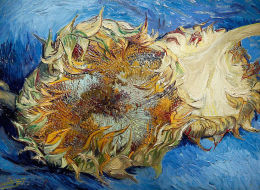
La palabra "girasol" trae a la mente una melena de vibrantes pétalos amarillos que rodean un remolino oscuro de semillas. Pero no todos los girasoles son iguales. Algunos girasoles tienen "pétalos" escuálidos, por ejemplo, o pequeños centros. Muchos de los girasoles de Vincent van Gogh que aparecen en su famosa serie de pinturas al óleo poseen un aspecto bastante inusual, exhiben florecencias "lanudas" de crisantemo. Ahora, los científicos han identificado la mutación genética responsable de la abundancia de estos girasoles extraños de pequeños pétalos amarillos.

Una flor típica de girasol está compuesta de dos diferentes tipos de flores. En el centro de la cabeza del girasol, discos florales se disponen juntos en superposición de espirales. Estas flores coronadas de pequeñas flores tubulares, llevan el polen y finalmente se convierten en semillas. Cada uno de los grandes pétalos amarillos en las franjas familiares del girasol es una flor en si misma -liguladas estériles (témpalos) que han evolucionado para parecerse a los pétalos de la flor gigante. Las pinturas de Van Gogh de finales de 1880, no solamente presentan claramente algunos de estos girasoles típicos, sino que se combinan con lo que parecen a borrosos pompones atrapado en los tallos de girasol.

sunflowers
Un girasol típico está a la izquierda, una variedad de doble flores en el centro y un mutante tubular en el tercer cuadro. Las flechas señalan dos flores mutantes en la pintura de Van Gogh (Crédito: John Burke, de la Universidad de Georgia)
Tales girasoles de doble floración, como se les conoce, tienen superposición de filas de pétalos amarillos flexibles y un centro pequeño, a veces oculto. En un nuevo estudio, John Burke, de la Universidad de Georgia y sus colegas identificaron el arreglo inusual floral de girasoles de Van Gogh con mutaciones de un gen crítico individual. Los hallazgos aparecen en el ejemplar del 29 de marzo de PLoS Genetics.
van-gogh-sunflowers
Van Gogh "Jarrón con quince girasoles" (Foto: Wikimedia Commons)
Burke y sus colegas trabajaron con girasoles típicos, así como con cultivos de doble floreción como el girasol oso de peluche, que se parece a un diente de león gigante. Al cruzar distintas variedades de girasoles uno con el otro y el cruce de sus descendientes con ellos mismos, los investigadores descubrieron que los  cultivos de doble floreción han mutado las formas de un gen llamado HaCYC2c. Por lo general, el HaCYC2c sólo se activa en florecillas. Burke encontró que los girasoles de doble floración activan este gen en tubulosas del disco también, así se presenta la transformación del girasol entero en una bola erizada de florecillas. En los girasoles mutantes, HaCYC2c parece contener un trozo sobrante de ADN que juega con el encendido / apagado del gen. Burke también creó girasoles en los cuales el HaCYC2c nunca fue expresado o han producido proteínas deformes; en esos girasoles, las florecillas no se desarrollaron correctamente y la espiral de las semillas fue rodeada con tubulosas de disco inusualmente grandes. 
teddy-bear-sunflower
Un girasol del oso de peluche es uno de varios estudios doble mutantes de flores (Foto: Wikimedia Commons)
Durante miles de años, la gente ha ido cultivando los girasoles por sus semillas, el aceite y su belleza. Los primeros girasoles de doble floración probablemente surgieron de forma natural debido a una mutación aleatoria, Es probable que los cultivadores aprovecharan la oportunidad para preservar las cualidades únicas de los mutantes y ofrecer a los clientes un nuevo tipo de girasol.

Aparentemente, Van Gogh fue uno de tales clientes. Sin embargo, a los girasoles de doble floración podría que no les fuese tan bien fuera de la vasija de cocina o el estudio del artista. Algunos girasoles de doble floración son demasiado estériles para reproducirse adecuadamente, ya que no tienen ninguna florecilla con polen. Y por lo menos un estudio sugiere que la pérdida de los genes de la familia de HaCYC2c hace a las flores menos atractivas para los insectos polinizadores. Afortunadamente para el girasol, incluso los mutantes, su futuro sigue siendo brillante. Los girasoles nos han embrujado tanto con sus disposiciones alegres que no es probable que dejen de crecer a corto plazo.

martes, 3 de abril de 2012

El Arte de la Ciencia

ORIGINAL: Princeton

Click the thumbnail images below to learn about the science behind the art.


First Place

Second Place

Third Place


Estudia la ciencia del arte y el arte de la ciencia.
- Leonardo da Vinci

El arte de la exposición de la ciencia explora la interacción entre la ciencia y el arte. Estas prácticas implican la búsqueda de esos momentos de descubrimiento cuando lo que percibimos de repente se convierte más que la suma de sus partes. Cada pieza de esta exposición es, a su manera, un registro de esos momentos.

Este es la quinta versión de la competencia de Ciencia organizado por la Universidad de Princeton. La competición de 2011 atrajo 168 propuestas de 20 departamentos. La exposición incluye el trabajo de estudiantes, profesores, personal de investigación, estudiantes graduados y antiguos alumnos.

Las 56 obras seleccionadas para la exposición de Arte 2011 de la ciencia representan este año el tema del "diseño inteligente", que interpretamos en el sentido más amplio. Estas imágenes extraordinarias no son arte por el arte. Más bien, se produjeron durante el curso de la investigación científica. Los participantes fueron elegidos por su excelencia estética, así como el interés científico o técnico.

Agradecemos a todos los que han presentado su trabajo a la competencia de este año. Nos sentimos inspirados por la amplitud de su creatividad, expresada tanto en la investigación científica y en los frutos artísticos de esa investigación.

Estamos muy agradecidos a nuestros patrocinadores, sin cuyo apoyo esta competencia no podría haber tenido lugar: El Centro de Lewis, Princeton Instituto de Ciencias de la Computación e Ingeniería (PICSciE), Princeton Plasma Physics Laboratory, de la Oficina del Decano de Investigación, el Museo de Arte de Princeton , y la Escuela de Ingeniería y Ciencias Aplicadas, y el David A. Gardner '69 Fondo en el Consejo de Humanidades.

Un agradecimiento especial a nuestro distinguido panel de jueces: David Dobkin, Decano de la Facultad, Joel Smith, curador de fotografía en el Museo de Arte, y Shirley M. Tilghman, Presidente.

Gracias también a las muchas personas que contribuyeron a este esfuerzo masivo: Neil Adelantar, Cantor Laurel, Chenoweth Damaris, Fanny Chouinard, Robert Clark, Clay Andrea, Cahir Ian, Chupa Michael, Csogi Pablo, Pablo Debenedetti, Grieb Dale, Elbrecht Jim, Karla Ewalt, Christine Fairsmith, Flamard Karen, María Florevel Fusin Wischusen-Gage, Cristina, Linda Geraci, Emmet Gowin, Caroline Harris, Mark Harris, Susan Kalmbach, Robert Kennedy, Knipe Nicola, Lian Christine, Litostansky Eric, Michael Littman, MacPherson Kitta, Rory Mahón, Mameniskis Andrea, Carol Peters, Eric Quiñones, Reed Candy, Rigolot Carol, Rosen Rafael Schultz, Steven, Lynn Shostack, AJ Stewart Smith, Ruth Stevens, la Tate Annette, Jeroen Tromp, Tu Evelyn, Valenza Bárbara, Mike Viola, Welles Holly, Westergaard Maggie, Wieser Patti y Zandonella Catalina.

- 2011 Arte de los organizadores de la ciencia: Zach Donnell, Departamento de Biología Molecular y Adam Finkelstein, del Departamento de Ciencias de la Computación; Christina Gupfinger '12, Departamento de Ecología y Biología Evolutiva; Teresa Riordan, Facultad de Ingeniería y Ciencias Aplicadas, y Zwicker Andrés, Princeton Plasma Physics Laboratory. También estamos agradecidos por la ayuda y el asesoramiento de los organizadores de los miembros fundadores de 2005 y 2006: Andrew Moore, Alex Halderman, Lovasz Kati, Finkelstein Adán, Jonathan Harris y Perry Cook.


Acerca de | 2011 Fotos | 2010 Galería | Galería 2009 | Galería 2006 | Galería 2005 | Prensa | Contacto

Diseñado por Jonathan Harris y Grady Klein.