jueves, 31 de octubre de 2013

pixelstick - Light painting evolved

ORIGINAL: KickStarter
by Bitbanger Labs

Add photoreal images, abstract designs, and animation to your long exposure photos and timelapse. 


What's "light painting"?
In 1889, artist Georges Demeny created the first known light painting photograph, “Pathological Walk From in Front”, by attaching incandescent bulbs to his assistant’s clothing and taking a long exposure. The technique was groundbreaking and became the touchstone for 125 years of unique and compelling works of art. Photographers have since added colored lights and performed deft physical feats to capture interesting images, but the technology involved has remained remarkably similar to what Demeny used in that first image. Until today.

How do I start? Light painting is a fairly simple to do. 
The first step is to make sure you have the right equipment. Almost every DSLR, and most point-and-shoots, have a long exposure mode. It's as simple as choosing the length of the exposure (from a few seconds to a few hours) and moving a light source within the frame. The process itself is fun and the excitement of seeing what you captured immediately can be extremely rewarding.

If you’re like us, however, as you grow to love the medium, you’ll also grow frustrated with its limitations. Pixelstick sprang from our desire to break free of these limitations. Lightpainting involves thinking creatively and trying outlandish ideas in the pursuit of amazing pictures. Pixelstick broadens the horizon of what's possible. Over many months of shooting we found Lightpainting to be more entertaining and more rewarding than ever. We were consistently amazed by what we were able to capture; we can't wait to see what you can do with it, too.


The fine detail

Pixelstick reads images created in Photoshop (or the image editor of your choice) and displays them one line at a time, creating endless possibilities for abstract and/or photorealistic art. Taking this one step further, Pixelstick can increment through a series of images over multiple exposures, opening up light painting to the world of timelapse, and allowing for animations the likes of which have never before seen.


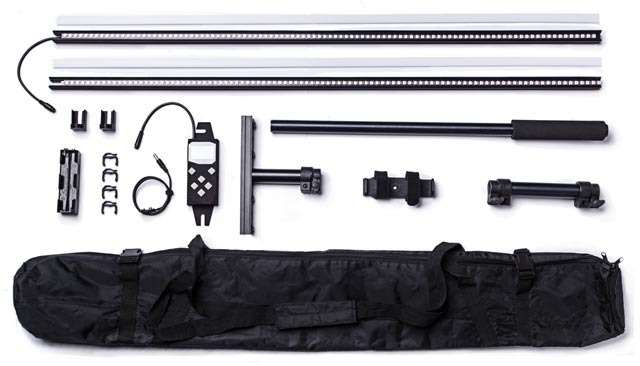
Pixelstick consists of 198 full color RGB LEDs inside a lightweight aluminum housing. Pixelstick’s brain, a small mounted box, reads images from an SD card and displays them, one line at a time. Each LED corresponds to a single pixel in the image. The images themselves can be from 1 to 198 pixels tall and many thousands of pixels wide. The handle is perpendicular and has a secondary aluminum sleeve, allowing pixelstick to spin freely. Pixelstick uses 8 AA batteries. Throughout testing we’ve used Sanyo Eneloop and Amazon rechargeable to great success, never requiring more than one set for a long night’s shooting.
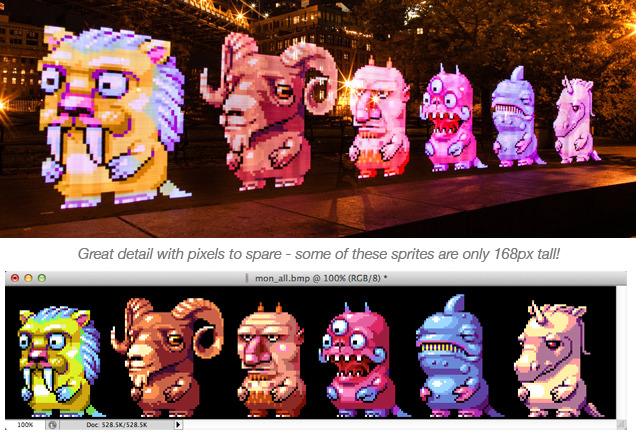
What do we get?

A central bracket connects the two 3' sections of aluminum housing and provides a mounting point for the handle. Over many designs we found that the perpendicular handle allowed for the most natural movement for both linear striping and more organic, abstract movements. A rotating sleeve sits over the handle and can be locked tight when not in use, or loosened allowing Pixelstick to spin freely.

The handbox not only allows you to select which image to load, but controls brightness, tint, firing speed, vertical flip, and left/right direction. There is also a port compatible with remote camera triggers (Canon C1) for wireless shooting.

The entire unit is matte black, rendering it virtually invisible to long exposures. A mounting channel runs the full length of the back. This slot accepts 1/4-20" threaded bolts, standard to the camera world, and allows you to get creative by mounting things to Pixelstick and mounting Pixelstick to things.

Sturdy caps protect each end of the Pixelstick, while cable clips keep everything snug against the housing.


The full package contains:
  • LED PCBs (198 LEDs total)
  • Two 3’ aluminum extrusion with connecting bracket & diffusion lens
  • Handle with foam grip and rotating sleeve
  • Controller box with connecting cables and clips
  • Battery holder (AA Batteries not included)
  • Carry bag
The Tale of pixelstick

The Beginning
Pixelstick began as a proof of concept using an arduino and some off the shelf LED strips. We got results, but weren't happy with the resolution of nor with the durability and usability of the actual device. We moved quickly into custom LED circuit boards, a more powerful ARM microcontroller and a sturdier design made of lightweight aluminum rather than plastic tubing. With the ability to control the density of the LED count while at the same time refining the custom aluminum extrusion, the current version of pixelstick began to take shape.

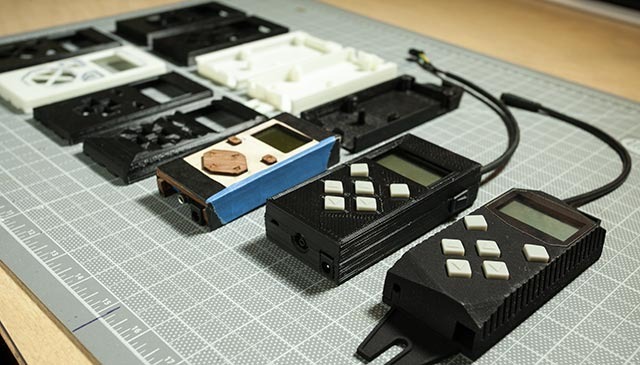
Our early controller prototypes were bare circuit boards, followed by a rather quaint wooden handbox (which we still quite like), and eventually on to higher and higher fidelity 3d printed enclosures. Each iteration performed better and was tweaked as we logged more hours with the pixelstick.
PCB Evolution

Just a few of the controller iterations
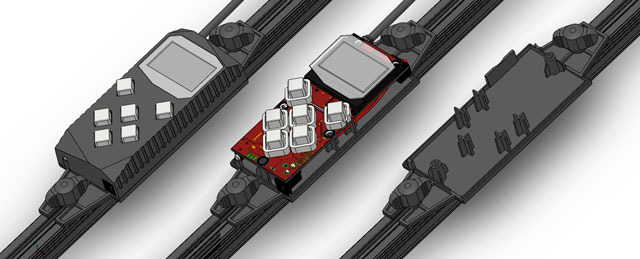
Controller Handbox and PCB
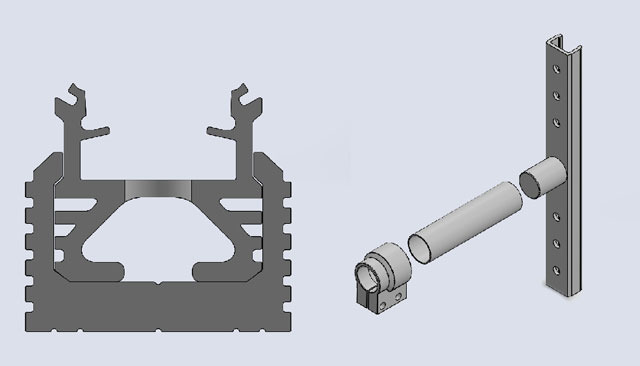
The handle went from a small stud, to a long vertical bar, and then eventually to a perpendicular tube with an attachment for spinning. We are still continuing to tweak the design as we move forward and have already committed to having a second extrusion made that will be more compatible with off the shelf nuts and bolts, so that replacements and extra hardware will be much easier for to source.
Extrusion profile next to Bracket/Stud
The MiddleWhen pixelstick is funded we'll be able to start production in earnest. Our circuit board will have its final stress testing and bug checking done before we lock in one of the multiple PCB manufacturers we have lined up. Once this is set we will have an initial small run of fully assembled PCBs made to test the vendor and make sure that no issues arise on the assembly line. Concurrently, we will do a final round of 3d prints of our handbox and revised extrusion design before moving forward with the tooling for the extrusion die and injection molds. Upon receipt of our new tooling we will do trial runs of both the extrusion and injection molded components. At this point we will have all the parts to make a fully assembled pixelstick as it will ship to our backers. It is here that we will do a final check to make sure everything comes together as expected and is up to our standards. When we are satisfied we will go into full manufacture on all components and begin producing and shipping pixelstick to our backers.
What's the money for?

It's surprisingly expensive to produce just one of something. Your pledge will help cover initial costs such as tooling for injection molding, and aluminum and plastic extrusions. Additionally, the cost of manufacturing only becomes feasible when we meet the minimum order requirements for our various vendors. This means that we must have a have a certain number of Pixelsticks spoken for before we can begin the process of manufacturing them.

We have a fully functional prototype, a design that we’ve refined over months of shooting, and multiple manufacturers lined up for every phase of the project. We need only the support of interested folks like you to put Pixelstick on the map and change light painting forever.
Rewards
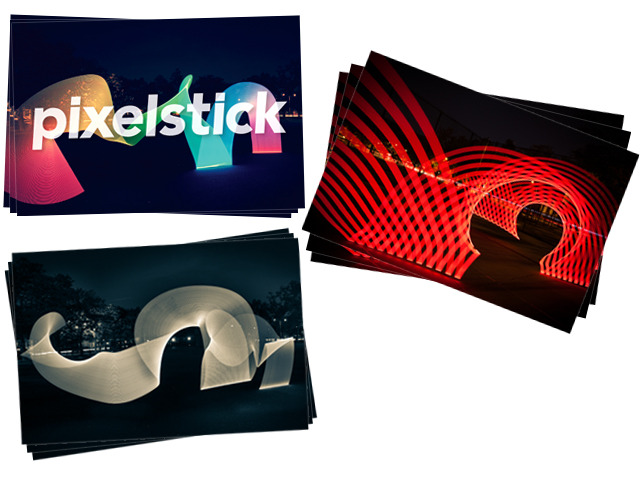
$10 - Pack of three 4 color, double sided postcards
$25 - 18x24 poster print
$300 ($250 for Early Birds!) - Pixelstick kit with Carry bag
Credits & Attributions

Music:
Pixelstick Montage music: Stormburner by Programs
Lightpainting Explained music: As You Want by Irregular

Artwork:

** Polaroid Pic - imustbedead Photography **
Graffiti - yeeerrrp on Reddit
Boombox - Paul Robertson (@probbz)
Scary Monsters - Cure

Various Lightpaintings:
Danimal1010 on Reddit
cal_mopho on Flickr
Crashburn on Wikimedia
Peter Thurgood on Wikimedia

The Pixelstick project will require managing several manufacturers and overseeing assembly of what these factories produce into a final product. Bitbanger Labs has experience dealing with these potential challenges from our previous project, Remee, which experienced some production delays because of components shortages and minor quality control issues. While this did cause a small delay in fulfillment, ultimately we are proud to say that we delivered a quality reward to all of our Kickstarter backers. To mitigate some of these potential risks, we have created relationships with multiple vendors prior to launch, so that we are able to react quickly should any problems arise during production of Pixelstick. While no production run is without its hiccups, we think our previous experience in not only managing a large project but also keeping our backers engaged and informed throughout the process equips us with all the tools necessary to bring Pixelstick to life.

FAQ

What size/format images should I use with Pixelstick?

Pixelstick images are 24-bit uncompressed .bmps, and should be 198 pixels high, which allows each LED to correspond to an individual pixel in the image. The images can be many thousands of pixels wide. Images that are more than 198 pixels in height are cropped by the stick when used but the file remains unaltered. For best results, we recommend resizing all larger images to the correct height, as well as experimenting with various resampling options to get the sharpest, most accurate resize.

domingo, 27 de octubre de 2013

Camila Botero: Premio al talento joven en artBo

ORIGINAL: El Tiempo
La obra de Botero tiene video, fotos impresas sobre papel de algodón y una línea de neón en la que se lee Detroit.Foto: Archivo particular
Por obra sobre Detroit, Camila Botero fue galardonada en la Feria Internacional de Arte de Bogotá.


La Feria Internacional de Arte de Bogotá, artBo, concedió este sábado el Premio Prodigy Beca Flora a Camila Botero, una de las 23 artistas que fueron seleccionadas para exponer en el pabellón Artecámara, donde se presenta el trabajo de las nuevas generaciones de creadores nacionales.

Es la primera vez que se entrega este reconocimiento, que es apoyado por EL TIEMPO y W Radio, cuya finalidad es generarle oportunidades a la escena joven local. El anuncio del ganador lo hizo la directora de la Feria ArBo María Paz Gaviria, en compañía de Roberto Pombo, director de este diario, y los curadores que actuaron como jurados: Maria Inés Rodríguez, Juan Sebastián Ramírez y José Roca.

Por su trayectoria como artista, la solidez conceptual de su obra y la calidad de la misma, Botero fue escogida como ganadora por los jurados María Inés Rodríguez, curadora del Foro Académico; Sebastián Ramírez, curador del pabellón Artecámara, y José Ignacio Roca, curador de los Proyectos Individuales. “Nos reunimos, miramos cada una de las piezas, y Sebastián Ramírez nos explicó no solo las obras, sino que nos dio un contexto de los artistas; de hecho, conocía algunos de sus talleres”, dice Roca, reputado curador nacido en Barranquilla y director artístico del espacio independiente Flora.

Botero, de 37 años, hará una residencia artística en Flora, donde contará con el acompañamiento de Roca, y participará en las jornadas Puertas Abiertas, de ese sitio. Recibirá además una bolsa de producción para desarrollar su trabajo y podrá realizar, el próximo año, una exposición individual en la sala Artecámara de la sede Chapinero de la Cámara de Comercio de Bogotá, durante la décima edición de artBO.

La obra ganadora
Arriba y abajo en el futuro es una instalación que incluye fotografías, un video y una pieza de neón, en la que se lee la palabra Detroit y que hace alusión a esta ciudad del estado de Michigan (EE. UU.), conocida por el importante desarrollo que tuvo allí la industria automotriz en los años 60, pero que ahora cayó en bancarrota.

"Detroit" Foto: CamilaBotero.net
"Detroit" Foto: CamilaBotero.net
Botero desarrolló el proyecto entre 2011 y 2012 y su propósito era hacer un análisis de la transformación de la famosa urbe

Las fotos muestran sus edificios, que evidencian el abandono y el desierto en el que se ha convertido una ciudad que llegó a tener 2 millones de habitantes y que en el último censo contó escasamente a 700.000 personas. Son imágenes de los lugares donde viven y trabajan los últimos ‘guardianes’ de Detroit.

El video, que está fragmentado en historias que no duran más de un minuto cada una, registra la vida cotidiana de los que quedan. El trabajo se puede ver hasta mañana en Corferias.

¿Quién es Camila Botero?
Nació en Medellín, donde vive actualmente. Es maestra en Bellas Artes de la Universidad de Antioquia, con estudios de dirección de cine en la New York Film Academy (EE. UU.) y de análisis cinematográfico en el Centre d’Estudis Cinematogràfics de Catalunya (España).
  
Su obra abarca pintura, grabado, instalación, fotografía y video. Hace tres años realizó la residencia del programa Cedic (Casa Tres Patios y Ceroinspiración), en los límites de Ecuador y Perú, y ahora, con este premio, realizará una residencia en el espacio Flora, en Bogotá.

martes, 1 de octubre de 2013

Better Out Than In: Banksy to Descend on NYC for an Outdoor “Residency” in October


ORIGINAL: Colossal
October 1, 2013

http://www.banksyny.com/


October 1. Bansky
Banksy’s website updated a few minutes ago to announce Better Out Than In, “an artists residency on the streets of New York.” The ongoing event is accompanied by a phone number (800) 656-4271 that you can call with a specific code correlating to each artwork. The current recording for #1, shown above, involves a satirical message that completely skewers typical audio tours found in museums and galleries and pokes fun of the artist as well, referring to him repeatedly as “Ban Sky”.

Do you think he’ll make a new piece every day? That seems pretty grueling. Stay tuned to www.banksyny.com to find out.

viernes, 12 de julio de 2013

‘Parabolic Soap’ is a fusion of artificial / mechanical and natural behaviour


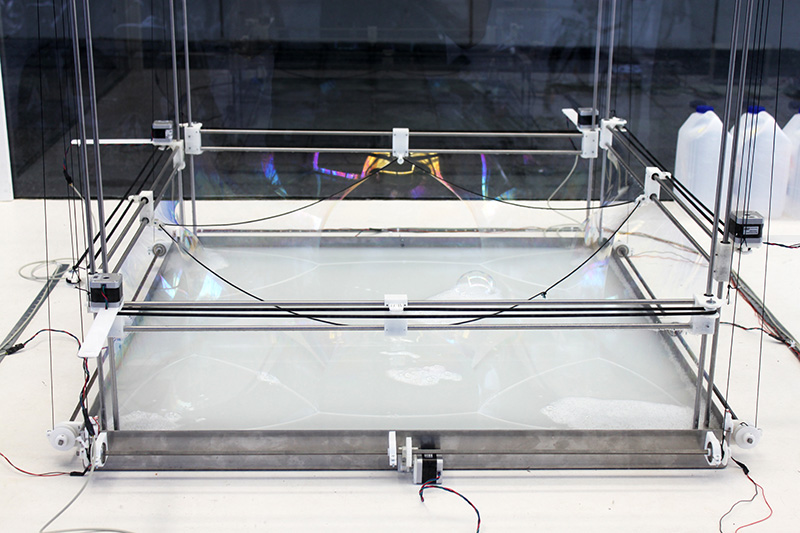
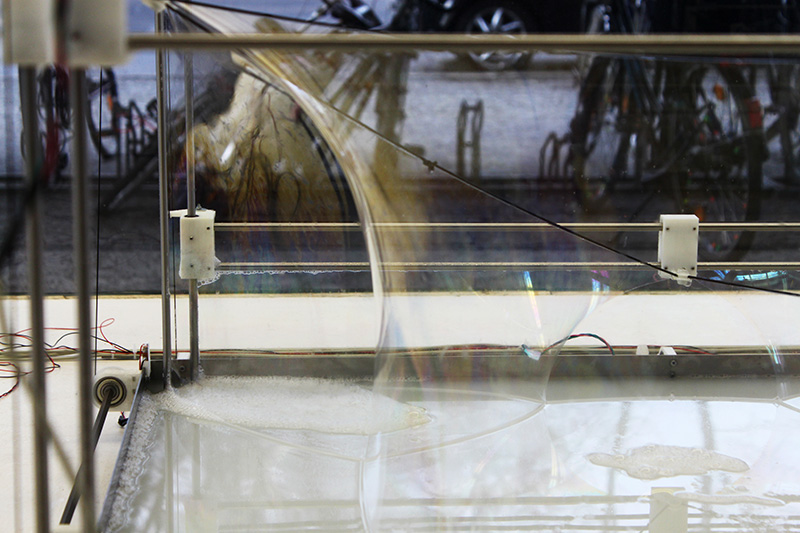
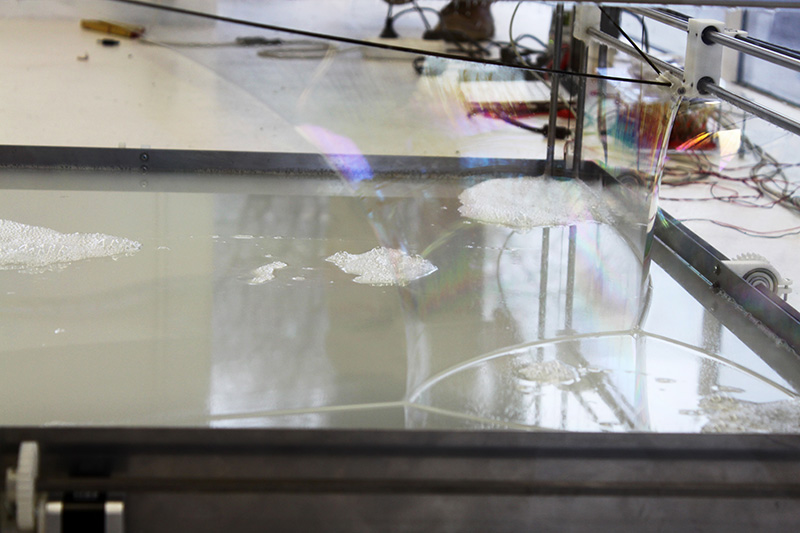
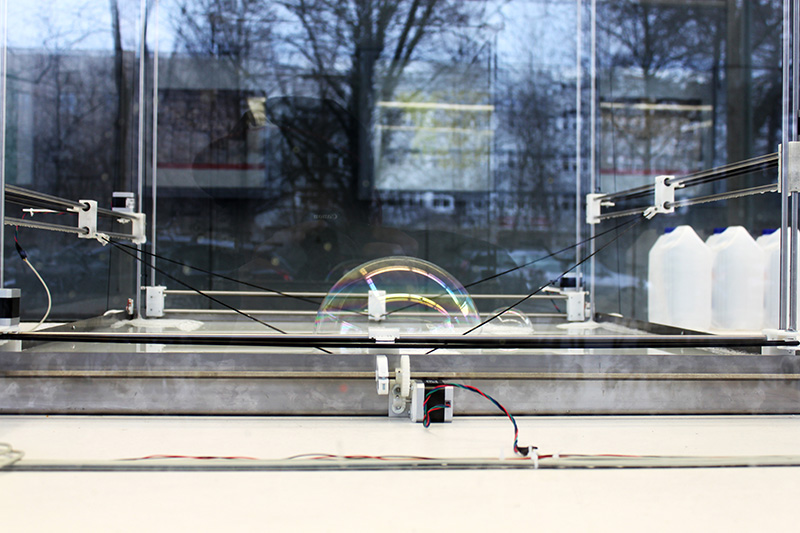
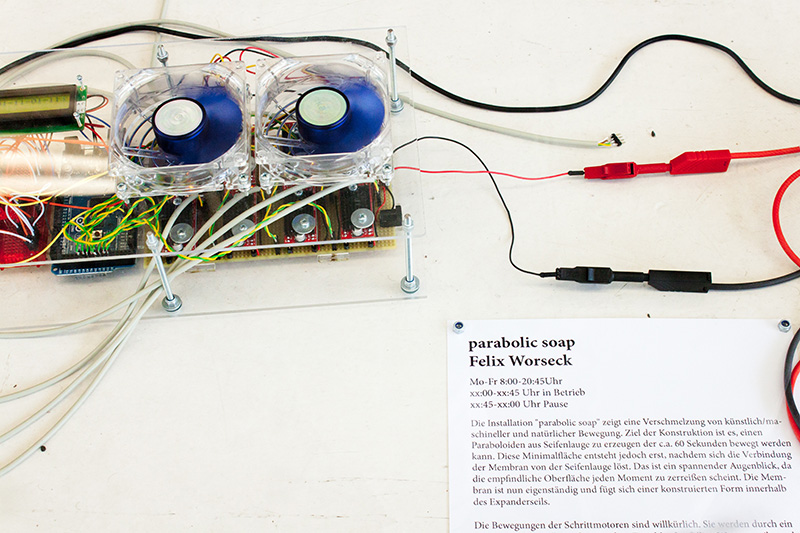
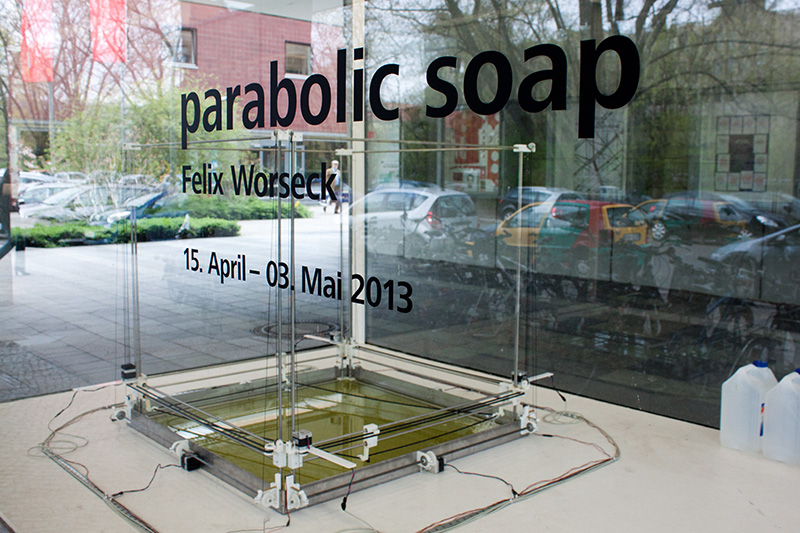
Created by Felix Worseck at the Berlin University of the Arts (Digitale Klasse), installation “parabolic soap” is a fusion of artificial / mechanical and natural behaviour. The aim of the install is to produce a paraboloid surface that can be moved for approximately 60 seconds. This minimal surface is created only after the connection of the membrane and the soap pool is broken.

The movements of the stepper motors are arbitrary. They are controlled by an Arduino program that assigns random values ??in each pass to the height of the four control axes. After the soap membrane is separated from the base, the machine moves back to the initial state and the sequence begins again.

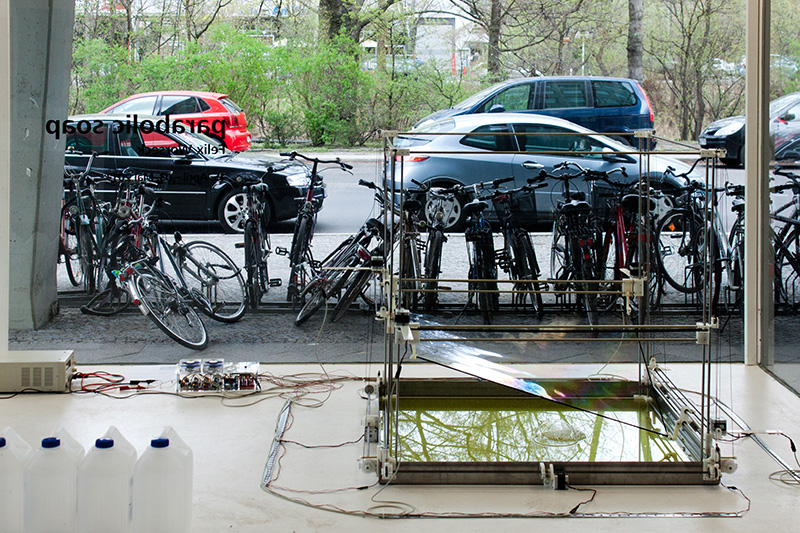
Components: Arduino, Easy Driver, Stepper Motors, 3D printed joints.

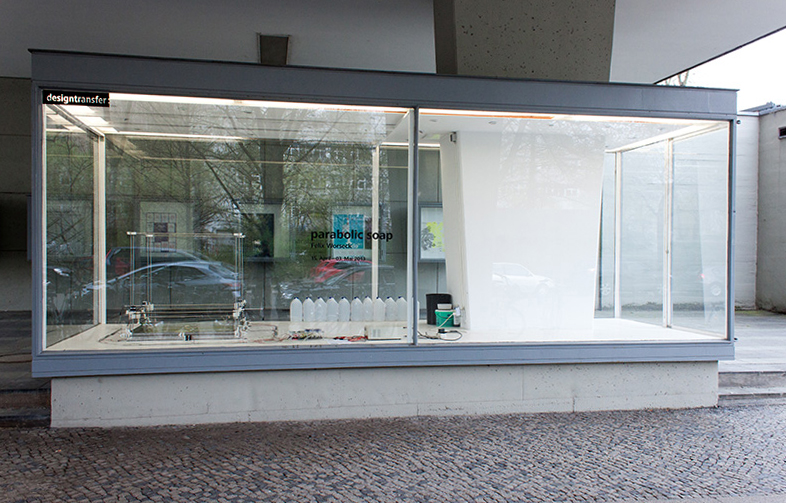
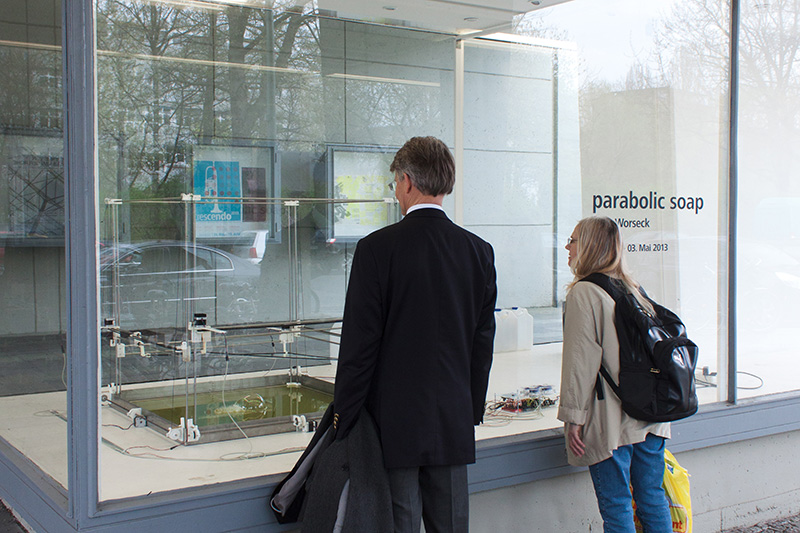
The 1 cubic metre installation was shown in glass casing on Einsteinufer 43-53 street in Berlin from 15th April until 3rd May 2013.

Project Page | Felix Worseck
parabolic-soap_02parabolic-soap_10parabolic-soap_09parabolic-soap_08parabolic-soap_04parabolic-soap_07parabolic-soap_06parabolic-soap_03parabolic-soap_01


BIQ, World’s first microalgae façade goes ‘live’

ORIGINAL: IBA-Hamburg 
by BIQ
25 Apr 2013

Natural, efficient and unique: the BIQ is setting new standards as the first building in the world to have a bioreactor façade. Microalgae are cultivated in the glass elements that make up its “bio skin”. These are used to produce energy, and can also control light and provide shade. Inside, an innovative living concept is aimed at ensuring maximum design versatility for everyday life, and gives us a glimpse into urban life in the future. With its innovative living concept, futuristic exterior, and “intelligent” algae façade, the BIQ is a highlight of ”The Building Exhibition within the Building Exhibition”.


A Building with a Second Green Skin 
The sides of the building that face the sun have a second outer shell that is set into the façade itself. Microalgae – tiny plants, most no larger than bacteria – are produced within this shell. They enable the house to supply its own energy. The only thing that the algae have to do is simply to grow. They are continuously supplied with liquid nutrients and carbon dioxide via a separate water circuit running through the façade. With the aid of sunlight, the algae can photosynthesise and grow. This façade is the first of its kind in the world and makes use of the very latest energy and environmental technology.
 

Microalgae – a Smart Energy Solution 
The algae flourish and multiply in a regular cycle until they can be harvested. They are then separated from the rest of the algae and transferred as a thick pulp to the technical room of the BIQ. The little plants are then fermented in an external biogas plant, so that they can be used again to generate biogas. Algae are particularly well suited for this, as they produce up to five times as much biomass per hectare as terrestrial plants and contain many oils that can be used for energy.


An Energy Concept that Calls upon Natural Forces 
The BIQ has a holistic energy concept: it draws all of the energy needed to generate electricity and heat from renewable sources – fossil fuels remain untouched. It is able to generate energy using the algae biomass harvested from its own façade. Moreover, the façade collects energy by absorbing the light that is not used by the algae and generating heat, like in a solar thermal unit, which is then either used directly for hot water and heating, or can be cached in the ground using borehole heat exchangers 80 metre-deep holes filled with brine. This remarkably sustainable energy concept is therefore capable of creating a cycle of solar thermal energy, geothermal energy, a condensing boiler, local heat, and the capture of biomass using the bio-reactor façade.


More than just a Shell: the BIQ Demonstrates what Tomorrow’s Façades can do
The BIQ building shows that in the future façades will be able to serve a number of different functions, and be much more than an aesthetic cladding to protect against rain and cold. While the northeast- and northwest-facing sides of the building have an elaborately decorated shell to draw the eye, the algae within the southwest and southeast façades produce biomass for renewable energy. In addition, the façade also serves the conventional purposes of insulating the building from sound, heat, and cold, and provides shade in bright sunlight. Spacious balconies give the residents sweeping views over the park, as well as the chance to see the natural power plant contained in the algae façade up close. However, visitors can also observe this film of matter as it grows. The greenness of the façade shows that the algae are breaking down the carbon dioxide and processing it through photosynthesis. This renewable form of energy production is thus visible from outside the building, and is an intentional part of the architectural concept.

Living on Demand
Inside, the BIQ reveals how we might live in the future. The ever greater interconnectedness between living and working and the increased demand for adaptable housing spaces means that there will be a call for versatile residential ground plans in the future. Two of the total of fifteen apartments to be housed in the BIQ do not have separate rooms, but rather enable the inhabitants to configure their living arrangements “on demand”. Depending on their needs, individual functions of the apartment – bathroom, kitchen, sleeping area – can be swapped about or combined to form a “neutral zone”. In this way, the necessities of everyday life determine the appearance of the apartment, and the versatile layout can be adapted to suit the residents and their daily lives at any given time.

Biomimicry: Mother Nature as a 3D Printer?

ORIGINAL: Triple Pundit
By Tamsin Woolley-Barker, Ph.D
July 11th, 2013
Last month, over 350 bio-inspired futurists from all over the world came together to ask how humans can learn from the rest of nature to create conditions conducive to Life. Not just sustainable economies, cities, and production systems, but a fundamentally new way of life that creates abundance, just as coral reefs and rainforests do. Welcome to the first Biomimicry 3.8 Global Conference, at the University of Massachusetts in Boston.

As I posted last week, the Conference’s opening day focused on “Generous Cities.“ These are urban environments that operate as regenerative ecosystems, actually improving the air, water, and land. On the Conference’s second day, that focus deepened and shifted away from buildings and cities, to the logistics of getting it done. “How would nature actually design the materials we need to build these cities?” Because, “at the end of the day,” said green chemist John C. Warner,we can only make products that are as sustainable as the building blocks we make them with.

We humans tend to solve each problem by creating a new polymer or plastic, none of which co-evolved with creatures to eat them. The result is that our “solutions” end up littering the Earth in perpetuity. Alternately, with all the cheap fossilized carbon lying around for us, it’s easy to apply energy to the problem: just plug it in and power it up! Unfortunately, burning yesterday’s carbon is changing the chemistry of our atmosphere faster than its inhabitants can adapt to it.

How would nature manufacture it?
Contrast our “plug-in/plastic” approach with that of our fellow Earthlings. Not having figured out how to eat fossils, they are on a pretty tight budget. They can only burn what they eat, and they have to make solutions from their own bodies or things they find around them. This leads to low-cost, highly-efficient structural solutions that use a handful of polymers, respond to the environment in adaptive ways, and can be broken down and reused by other creatures. This kind of problem-solving results in the highly interconnected and incredibly rich web of collaborative interdependence we call Life.

The flaccid sea cucumber, for instance, instantly goes rigid as a kevlar jacket, simply by changing the orientation of tiny cellulose “whiskers” in its gelatinous tissues. Likewise, tiny pores on the leaves of plants open up gracefully, breathing carbon dioxide for photosynthesis, then clamp shut minutes later to conserve precious water. The action is passive, triggered by changes in light, carbon dioxide concentrations, and water availability.
Learn from the ostrich egg  
Tom McKeag, editor of the beautifully-designed and award-winning bio-inspired digital magazine, Green Chemistry, set the stage for the idea of “regenerative manufacturing.” In a thought-provoking workshop called “Learning from the Ostrich Egg,” he presented the participants with a huge but humble marvel of engineering and clean design. What can our designers, material scientists, and architects learn from the egg? McKeag described its contradictory functional requirements. The egg must be strong enough to survive a precipitous drop from a very tall bird, then break apart for the tiny chick to hatch. It must be easily turned by the parent, but not roll away. Waste gases escape, but nourishing fluids remain. All these things and more are accomplished, using very few materials, all locally sourced and recyclable. The egg’s contradictory specifications, said McKeag, are what drive innovation and exquisitely efficient design.

3D printing revolution

The highlight of the day was a riveting presentation by MIT Media Lab Director Neri Oxman. Named one of Fast Company’s 100 Most Creative People, Oxman’s talk captivated the audience. She is at the forefront of the 3D printing revolution, looking to create synthetic “smart” materials that act as natural ones do. In nature, said Oxman, bones thicken in response to force, leaves grow toward light, and trees branches are shaped by wind. Why not a wrist splint that adapts to where you feel pain? Why not a lounge chair that shapes to your body and adjusts to your weight? With 3D printing, these possibilities become real.

A quick glance at an industrial manufacturing catalog will tell you that engineers like to assemble bits and parts. But that’s not how nature builds. Instead, living systems use a stripped-down palette of self-assembling materials that act in dramatically different ways with simple structural changes at the nano-, micro-, or macro level. The soft skin on your face, for instance, is not the same as the nasty stuff on the soles of your feet. An antelope’s hair, hooves, and horns are all made of keratin, but each does a quite different thing. We can do this with our materials too. What about printing with fiber optics to produce light-emitting objects? Or making a pair of glasses as a single piece that varies in transparency, rather than a separate frame and lenses?

But, said Oxman, our 3D printing technology has limitations. First, our feedstock is primarily non-structural plastic resin. Does it have to be? Not at all. The material can be whatever we decide it is as a society. Second, the size of the printing “frame” or gantry currently limits the size of the object. But what if we could scan and print freeform, using drones or robot arms? Third, current printers accrete horizontal layers, but living tissues build themselves organically, in three dimensions. How can we transcend our technology? Oxman’s team at MIT’s Mediated Matter set out to circumvent these limitations by developing the first freeform 3D printer, playing with different materials, and doing extensive digital consideration of desired objects. The result is a truly remarkable artistic vision of a not-so-distant, but radically transformative, future of “Making.”
Silk Pavilion

But as tantalizing as their findings were, Oxman said, the team remained frustrated by their primitive tools. Suddenly, she said, they hit on domesticated silkworms as living 3D printers, and the question became, “How would nature design a 3D printer?” They studied the “simple rules” used by silkworms in determining where and how to lay down silk, built a Buckminster Fuller-inspired geodesic dome scaffolding to elicit the desired responses, and released 6500 Bombina moryx silkworms. The worms “printed” the beautiful Silk Pavilion now hanging in the MIT Media Lab lobby, with “smart” variations in density and patchiness responding to light and substrate, consciously elicited by the team. In essence, the silkworm is a combined biocomputer and freeform printer, programmed by its DNA, printing with a biodegradable (and lovely) material, produced on-site simply by feeding the silkworms.

When asked what the future holds, Oxman lit up. She suggested that we could print objects perfectly designed by the requirements of a space itself. We could print with carbon nanotubules, effectively making a 4D printer that produces objects that adapt over time. This material would be “alive,” responding to light, heat, force, or humidity to create “smart” objects that adjust automatically to their environment. Or, she suggested, we could print large structures, like homes and bridges, using variable-density concrete to provide extra strength where it is needed and conserve material where it is not. She floated the possibility of changing the “printing material” or the “simple rules” of production through genetic engineering (like having silkworms print with spiderweb), or using other “living printers” like spiders, mushroom mycelium, vines, or corals. Could we cultivate self-assembling underwater structures from CO2, just as corals do today? The printers of the future could be robots inspired by these organisms, or something else entirely: a living scanner, printer, and biocomputer. Imagine “growing” your home, lighting, and furniture from “genetic blueprints” downloaded off the internet into a robot or a made-to-order living entity?

This vision elicited a predictably polarizing response from the audience. Many were horrified by the hubris of genetically engineering living creatures to act as our slaves. Biomimicry 3.8 Co-Founder Janine Benyus expressed this sentiment, standing up to say that biomimicry hopes to look beyond using organisms as raw resources, to a deep “process of learning from other fabricators. If you’re wearing cotton, a plant made it for you. If you’re wearing wool, a sheep made it for you. It’s time for humans to start making our own materials.

3D printing represents a transformative opportunity for us to redesign our manufacturing and consumption patterns, she said, pointing out that a great many of our machine parts are used to cut or grind away, literally subtracting, discarding, and wasting our planet’s precious resources. 3D printing, by contrast, is an additive process, using only what is needed. The time is coming, Benyus said, when we will “Make” everything we need at our neighborhood “Maker Shop,” exactly what, when, and where we need it, without waste or energy-intensive shipping. “But,” she added, “let’s make sure these printers aren’t tiny volcanoes on our desks,” dropping humanity out of the frying pan and into the fire. She implored the audience to make sure that locally abundant and benign feedstocks (ideally from the excess carbon dioxide in our atmosphere and oceans) become standard, materials that can be enzymatically digested at the end of product-life and fed back into our printers. Just like Nature would do it.

Dr. Tamsin Woolley-Barker is an evolutionary biologist, writer, and Biomimicry 3.8-trained sustainability and biomimicry consultant. She blogs at BioInspired Ink and serves as Content Developer for the California Association of Museums’ Green Museums Initiative. She is working on a book about organizational transformation and resilience inspired by living systems.

[image credits: Kevin Krejci, Nasturtium Leaf, Ed Bierman, Sea Cucumber, Colin Raney, Silk Pavilion at MIT]

Silk Pavillion – CNC Deposited Silk & Silkworm Construction at the MIT Media Lab


Project Video  (HQ)


Silk Pavillion
2013 CNC Deposited Silk & Silkworm Construction
MIT Media Lab

Prof. Neri Oxman, Markus Kayser, Jared Laucks, Carlos David Gonzalez Uribe, Jorge Duro-Royo

The Silk Pavilion explores the relationship between digital and biological fabrication on product and architectural scales.The primary structure was created of 26 polygonal panels made of silk threads laid down by a CNC (Computer-Numerically Controlled) machine. Inspired by the silkworm’s ability to generate a 3D cocoon out of a single multi-property silk thread (1km in length), the overall geometry of the pavilion was created using an algorithm that assigns a single continuous thread across patches providing various degrees of density. Overall density variation was informed by the silkworm itself deployed as a biological printer in the creation of a secondary structure. A swarm of 6,500 silkworms was positioned at the bottom rim of the scaffold spinning flat non-woven silk patches as they locally reinforced the gaps across CNC-deposited silk fibers. Following their pupation stage the silkworms were removed. Resulting moths can produce 1.5 million eggs with the potential of constructing up to 250 additional pavilions. Affected by spatial and environmental conditions including geometrical density as well as variation in natural light and heat, the silkworms were found to migrate to darker and denser areas. Desired light effects informed variations in material organization across the surface area of the structure. A season-specific sun path diagram mapping solar trajectories in space dictated the location, size and density of apertures within the structure in order to lock-in rays of natural light entering the pavilion from South and East elevations. The central oculus is located against the East elevation and may be used as a sun-clock. Parallel basic research explored the use of silkworms as entities that can “compute” material organization based on external performance criteria. Specifically, we explored the formation of non-woven fiber structures generated by the silkworms as a computational schema for determining shape and material optimization of fiber-based surface structures. Research and Design by the Mediated Matter Research Group at the MIT Media Lab in collaboration with Prof. Fiorenzo Omenetto (TUFTS University) and Dr. James Weaver (WYSS Institute, Harvard University).

Selected Press: Creative Applications, DEZEEN, WIRED, FASTCOMPANY, ARCHDAILY, Treehugger, io9, jaxtapoz, CORE77, GIZMODO, Creator's Project, inhabitat, Forbes and more.

viernes, 3 de mayo de 2013

What Roboticists Can Learn From Art, and What Artists Can Learn From Robots

ORIGINAL: IEEE Spectrum
BY: Angelica Lim
May 02, 2013


You walk into the brightly lit space, and a delicate-looking plaster statue catches your eye. She has a peaceful expression, and is dressed in a modest gown with puffy shoulders and a broad skirt. Her arms stay close to her body, but the palms of her hands face gently forward, as if asking for something. As you approach, she suddenly glides forward to meet you. Her name is Diamandini, and she's a robotic statue.

Combining art and robotics is nothing new (in fact, it's something quite old), but in recent years the creations dreamed up by artists and roboticists are becoming more elaborate and striking, thanks, in part, to faster and cheaper sensors and computers. We've seen robotic sculptures that defy gravity, robots that canpaint andwrite, and squads of drones that play music, build towers, or perform choreographies. A number of workshops and festivals have gathered researchers and others interested in exploring the intersections of art and robots.

Over the last 15 years, art and technology have come together at the studio of Dr. Mari Velonaki. She is an artist and director of the Creative Robotics Lab at the University of New South Wales, in Australia. Velonaki and her team created the Diamandini installation at the Victoria and Albert Museum in London last fall.