lunes, 20 de enero de 2014

Emptied Gestures: Physical Movement Translated into Symmetrical Charcoal Drawings

ORIGINAL: This is Colossal
by Heather Hansen
January 20, 2014

Photo by Bryan Tarnowski

Photo by Bryan Tarnowski

Photo by Bryan Tarnowski

Photo by Bryan Tarnowski

Photo by Bryan Tarnowski

Photo by Bryan Tarnowski

Photo by Bryan Tarnowski

Photo by Bryan Tarnowski

Photo by Spencer Hansen at Ochi Gallery

Photo by Spencer Hansen at Ochi Gallery

Photo by Spencer Hansen at Ochi Gallery

Photo by Spencer Hansen at Ochi Gallery


Splayed across a giant paper canvas with pieces of charcoal firmly grasped in each hand, Heather Hansen begins a grueling physical routine atop a sizeable paper canvas. Her body contorts into carefully choreographed gestures as her writing implements grate across the floor, the long trails resulting in a permanent recording of her physical movements. Part dance and part performance art, the kinetic drawings are a way for Hansen to merge her love for visual art and dance into a unified artform. The final symmetrical patterns that emerge in each pieces are reminiscent of a Rorschach test, or perhaps cycles found in nature.

Hansen most recently had a group exhibition, The Value of a Line, at Ochi Gallery in Ketchum, Idaho which runs through March 31, 2014. All photography above courtesy the artist by Spencer Hansen and Bryan Tarnowski. If you liked this also check out the work of Tony Orrico. (via iGNANT, My Modern Met)

sábado, 18 de enero de 2014

It May Look Like a Normal Stack of Wood, But When You Get Closer…WOW!

ORIGINAL: Real Farmacy
Jan 14, 2014

From a distance, it appears to be an ordinary stack of firewood, but as you get closer, you begin to realize that this is way cooler than a stack of logs.

Upon further inspection you notice that the black lines are actually seams.

And they open! What is this thing?

Holy smokes! They’re the windows of a perfectly camouflaged cabin!

What an amazing creative way to hide out in luxury, surrounded by nature!

The man below is Hans Liberg, a Dutch performer.

He’s able to blend in with the scenery when he’s deep in a composition.

This fantastic creation was built on a trailer by Piet Hein Eek who was even more excited than Hans.

The outside is indeed real wood.

The one-of-a-kind window designs are made of steel and plastic.

The interior is quite roomy despite being contained in a stack of wood.

Windows on all four sides flood the quarters with natural light.

It’s perfect to rock out in.

What more does a musician need than a remote cabin and a guitar?

The illuminated wood stack at dusk makes for a fantastic photograph, to say the least.


Hans is as happy as can be. Wouldn’t you be too?


lunes, 13 de enero de 2014

Andy Lomas Lets Digital Systems Bloom In "Morphogenetic Creations" Exhibit

By DJ Pangburn
Jan 10 2014

Andy Lomas, a digital artist and mathematician, likes to let the virtual world spin out of control. Using software code to creates very basic rules, Lomas then sits back and watches his digital “growth systems” bloom, fractalize, shape-shift, and otherwise behave in organic and emergent ways.

Yesterday, at the Los Angeles Center for Digital Arts (LACDA), Lomas’s Morphogenetic Creations opened, giving digital art enthusiasts the opportunity to see his dynamic virtual systems up close. The exhibit includes work from the Aggregation, Flow, and Cellular Forms series. To coincide with the exhibit, Lomas uploaded a view of these digital growth videos to Vimeo. Startlingly beautiful to behold, they’re a bit like Ernst Haeckel’s Art Forms of Nature animated with a cyberpunk edge.


I recently rang up Lomas, who lives in the United Kingdom, to talk about Morphogenetic Creations. We talked about his background in mathematics, his early fascination with D’Arcy Wentworth Thompson’s On Growth and Form, and how his work as a computer-generated effects artist for film (The Matrix sequels and Avatar), where highly-predictable outcomes and stability predominate, served as a springboard for the more random digital forms he now creates.

The Creators Project: What can people expect to see at the Morphogenetic Creations exhibit at LACDA?

Andy Lomas: There will be four animation pieces from the Cellular Forms series in the windows, but also then some 44x44-inch big prints of new and old work. They’re ridiculously high-resolution at 12,000x12,000 pixels.


Another thing I have at LACDA for the Aggregation series are picture frames with these old, Victorian-style stereo viewers to create a 3D effect. The frame only contains two pictures, but through the stereo viewer it really looks like this three-dimensional thing. I believe they’re going to pull those out for this exhibit as well.

Is Cellular Forms the most recent series?

The two Cellular Forms videos are the most recent. They’re almost exactly the same date because they’re basically differently rendered versions of the same thing. That would be Cellular Forms and Cellular Forms (X-Ray version).


What I quite like is the idea that there are two things: the creation of these three-dimensional data structures, where the goal is to create the most organic things possible with very simple rules; and that there is no one correct way of doing that. One shows you everything solid, while the other gives you an x-ray that reveals what’s actually going on inside. Neither is the original, if you like. They’re just different views into the data.

And you wrote the software code for this series?
Yeah, I wrote the software for Cellular Forms. I’m a code junky. I write it for my own pleasure. There are two main parts to the code. 
  • One is what I call the simulation engine, which is the thing that is actually almost like running a growth process. It starts with a sphere or ball of cells, with rules for how they divide and have forces between them, how it moves, changes shape, and grows over time.  
  • Then there is the rendering stage, which takes the data produced by that simulation and turns it into something you can see. It produces pixel data out of cell data, if you like.

Did you use this code in your film work, or did you build it on the side for this specific purpose?
It’s completely built on the side. It’s very much a labor of love. When I worked on The Matrix sequels for this company I was working with then, another person there used a much simpler version of what’s called Diffusion Limited Aggregation for some of the effects work. It was used for when Agent Smith was turning other people into other Smith’s with these tendril things. DLA inspired the code I wrote.

When you’re doing things for films, you have to construct things in a very different way—you have to make things very controllable and directable. Whatever you do, when the director or visual effects supervisor looks at it and says, “That’s great, but can you change this and modify that,” that is what you spend most of your time doing. One of the things I like about my own work is that it is trying to be almost exactly the opposite. You’re hoping for the things which are unexpected.


It’s almost like growing plants; you don’t know exactly how a plant is going to grow. But, you start to learn that if you cross-breed that with that, then it might do something interesting. Maybe nine of the plants end up really uninteresting, but one does something really interesting and maybe different than what you thought it would. People talk about emergence, where things emerge that you didn’t expect, which you almost can’t use in professional production.

Do you prefer the lack of control that your solo work affords you?
I’ve got to say that I prefer the lack of control. As soon as things become digital, people think that they can control everything. When you get to a certain level of complexity, you can explore it more than control it. I prefer the things where 99% of the time it doesn’t produce anything interesting, but that 1% of the time is like, “Wow, that’s really cool.” I’m not a control freak director. I actually want the work to surprise me instead of do exactly what I thought it was going to do.


What specifically might have influenced Cellular Forms and your other series?
I’ve always been fascinated by sculpture and form. I also used to scuba dive and look at coral. To my mind, organic things go from really hideous to incredibly beautiful, whereas most engineered things go from ugly to something quite interesting. In organic forms, there is a very visceral reaction. Trees look beautiful and mold looks ugly, and things like that.


My original background is in mathematics, which I studied as an undergraduate. One of the main areas I got interested in is what’s called Dynamical Systems, which is sort of the math behind Chaos Theory and Complexity Theory—the math of how things change over time when you almost reapply the same rule again and again and again. So, the combination of those two, it’s almost like how simple could the rules be to make something that is as beautiful as a tree or coral or something like that. So, those two have always been like two germs working together. And, to my mind, computers are the things that allow you to actually try that out.


Any other critical influences in your work?
There was a Scottish mathematician named D’Arcy Wenthworth Thompson, who wrote a book about a hundred years ago now called On Growth and Form, which is basically him talking about the constraints of the real world. When you think about how things grow, are the sorts of forms that you see in the real world just the results of almost the only things that can grow? With a computer we can actually test that. Often, it doesn’t work quite how you expected.

For more of Lomas' work, head over to his website here.

@djpangburn

domingo, 29 de diciembre de 2013

Impossible art: Mind-bending, 3-D printed masterpieces

ORIGINAL: CNN
By William Lee Adams, for CNN
December 18, 2013
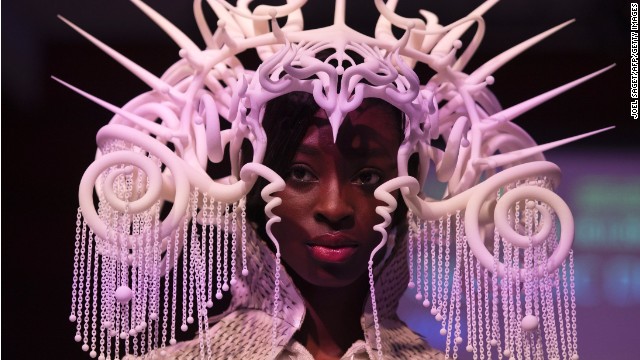
3-D printers deposit material layer by layer to create a solid object, as in this dramatic headpiece by Joshua Harker. In the past each of the elements would have been crafted separately and then pieced together. 3-D printing simplifies the process and prints the work in one go.

STORY HIGHLIGHTS
  • 3-D printing is opening new avenues for artists
  • The Van Gogh Museum is printing 3-D replicas of iconic paintings
  • Even Victoria's Secret has embraced the technology

(CNN) -- Thanks to 3-D printers, dentists can today print false teeth and medical device manufacturers can print hip replacements.

Such creations are useful, but not exactly sexy. Thankfully, artists are demonstrating another dimension of the technology, printing remarkable creations that wouldn't have been possible even a decade ago.

Take Tobias Klein. The German artist wanted to meld the architecture of St. Paul's Cathedral with representations of his own body.

Approximating the shape and dimensions of your own heart is a challenge, but Klein did not have to guess. He underwent a series of MRI scans, and then, with a few clicks of the mouse, was able to view his own heart in 3-D.
'3D' display lets you touch real world

Handbag designer pushes the envelope

Facial recognition failed in Boston
He then merged that with a representation of the dome of St. Paul's and sent the design to a 3-D printer, which deposited material layer by layer to create a solid object.

The result was 'Inversive Embodiment,' a twisting, mind-boggling sculpture that links man-made architecture with the architecture of a man.

"It allows me to move into more eccentric areas," Klein says. "We see a super beautiful influx of people working with the medium. We're just seeing how far this can go."

Read: Dawn of a new revolution: How 3-D printing will change the world

New possibilities
According to Wohlers Associates, a manufacturing research firm, the market for 3-D printing topped $2 billion in 2012, up nearly 30% from the year before. And while most of the cash comes from manufacturing companies, artists are throwing ever more dollars at 3-D printers and related technologies.

The desire to innovate is driving the trend, as are falling prices and the increased availability of 3-D printers.

Suzy Antoniw organized "3D: Printing the Future", an exhibition running at London's Science Museum until June 15.

"Although 3-D printing as a technology isn't that new, there has been an explosion of creativity around it in recent years," she says. "It gives artists more design freedom and enables them to create amazing things."

Bernat Cuni, one of the artists featured in the exhibition, takes children's drawings and, using computer aided software, blows the images up like balloons. A 3-D printer then produces these so-called 'crayon creatures,' turning scribbles into mini sculptures.
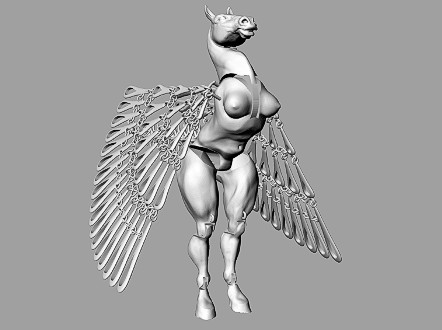
The Horse Marionette, made by 3D printing. Courtesy Michaella Janse van Vuuren
Michaela Janse van Vuuren, an artist and former puppet maker, focuses on designs that can only be made using 3D printing.

Her white horse marionette includes an elaborate set of wings made of countless interlocking parts, all printed in one go. That means there is no assembly required and the piece is ready for sale immediately.

"There is absolutely no way you can make this design using traditional manufacturing or handcraft methods," she says.

Fashion has benefited as well. It allows me to move into more eccentric areas," Klein says. "We see a super beautiful influx of people working with the medium. We're just seeing how far this can go."
Tobias Klein, artist

For the Victoria's Secret Fashion Show in September, the lingerie giant wanted model Lindsay Ellingson to have spectacular wings that captured the intricacy of snowflakes.

Designer Bradley Rothenberg relied on a 3-D printing process called Selective Laser Sintering that can fabricate complex interlocking support without additional support materials. 3-D printing also ensured a snug fit.

"We actually scanned the model and then wrote code that generated the snowflakes around the 3D mesh of Lindsay's body."

Read: Texas company makes metal gun with 3-D printer

Financial incentive

For artists who live outside of the world's major art markets, 3-D printing helps them access customers further afield.

Janse Van Vuuren
, who is based in South Africa, says it can be costly to reach new markets and to travel to meet potential clients.

"3-D printing removes many of these barriers and has the potential to level the playing field," she says. "My designs can be printed at a location close to the buyer and many online repositories exist where buyers can choose products."

Museums see commercial promise in new printing techniques as well.

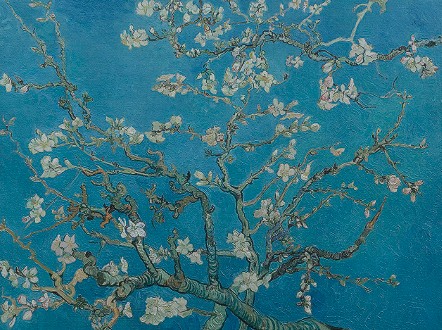
Amsterdam's Van Gogh Museum, which holds the world's largest collection of paintings by the Dutch artist, has teamed up with Fujifilm to create 3-D replicas of five Van Goghs, including the iconic "Sunflowers" and "Almond Blossom."

Fujifilm scanned the works and then printed 260 replicas of each—a process that takes three months.
Vincent van Gogh's Almond Blossoms. Courtesy Van Gogh Museum Amsterdam
Known as "Relievos", the copies capture not only the colors—there are 32 shades of yellow in "Sunflowers"—but also the particulars of Van Gogh's brushstrokes, including height and direction.

They also include the frame and the backside of each painting, which have stickers and other markers of where the paintings have traveled.

"This way people can see the history of the painting," says Milou Halbesma, the head of public affairs at the museum. "A painting travels around the world. People can see it was in exhibitions at the Moma and other museums."

The Relievos sell for €25,000 each, about $34,000, and will help the museum pay for essential renovations. Previous sales in Hong Kong and Taiwan were a huge success, so the museum has launched similar sales in Belgium and the Netherlands. It will take its works to Los Angeles in the new year.

Read: Victoria's Secret model wears 3-D printed wings

Baby steps

Critics of 3-D art reproductions like to point how much they vary from the original.

But Joris Dik, a professor of materials science at Holland's Delft University of Technology, believes it is more interesting to compare 3-D reproductions to earlier 2-D reproductions. It shows how far technology has come.

Working with Canon and the Rijksmuseum, Dik and one of his graduate students developed a scanning technique that allows them to capture the ridges and cracks of a painting, and to see beyond the surface layer of paint to understand the structure of the painting.

To the untrained eye their reproduction of Rembrandt's "Jewish Bride" might be mistaken for the original.

But for Dik that's not the point. What's important is that his 3-D representation is an incremental step forward. In the future 3-D scanning techniques and printing may even replicate layers and luminescence, the quality whereby particles in paint make it appear to shine.

"The one thing that is certain is that 3-D printing is advancing rapidly," Dick says. "I'm quite sure that in a couple of years we'll be a couple of steps further."

Gorgeous Computer-Generated Flowers Bloom: Photos


British philosopher and mathematician Bertrand Russell once said, "Mathematics, rightly viewed, possesses not only truth, but supreme beauty." One look at these computer-generated images from Daniel Brown and Russell's words come to life.

Brown, a London-based designer, programmer and artist who specializes in digital technology and interactive design uses custom algorithms to "grow" gorgeous floral artwork that will blow your mind. Here are 11 of our favorites.
Courtesy Daniel Brown


It all started in 1999, when Brown demonstrated a computer program and mathematical model that used special code to produce fractals. The resulting animations were almost hypnotic. "It was the first time I realized that non-technical people could aesthetically appreciate mathematical formulas if they saw them 'come alive,'" he said.
Courtesy Daniel Brown


Brown created the pieces in this slideshow for the Victoria and Albert Museum and the D'Arcy Thompson Zoology Museum, as well as projects for corporate clients. A swimming accident in 2003 broke Brown's spinal cord, causing paralysis. As a result, he uses a finger-splint device and a large track pad to operate a computer. Even without this added challenge, his flowers are uniquely beautiful; no two look exactly the same.
Courtesy Daniel Brown


Several years ago Brown produced a three-story-high projection of flowers for the Victoria and Albert Museum. Each petal generated contained combinations of images from the museum's textile collection. The work was named in honor of D'Arcy Wentworth Thompson, a pioneering bio-mathematician known for his 1917 book On Growth and Form.
Courtesy Daniel Brown


Last year, the D'Arcy Thompson Zoology Museum at the University of Dundee in Scotland contacted Brown after seeing his Victoria and Albert Museum work and asked him to create a piece for them. Brown said he used generative design to create the realistic flowers for this newer exhibition, which went up last spring. Each flower shape is determined by an algorithm that is then altered to take into account natural variation.
Courtesy Daniel Brown


Another mathematical formula is used to generate the color and texture applied to the shapes. Each arrangement is grown over about 50 seconds, resembling time-lapse photography that's been sped up. "After this, they fade out and another arrangement is created," he said.
Courtesy Daniel Brown


Brown's original pieces only used two-dimensional computer graphics that mimicked a 3-D look. However, in the past few years, computer technology has evolved so that he can simulate surfaces, behaviors and lighting in real time.

Sometimes Brown produces a flower that even amazes him. "I can't work out the particular parameters that would have gone into it, and am left scratching my head," he said. "Because the flowers regenerate every minute or so, it's a fleeting moment, and there is something almost poetic knowing that no one will ever see that one flower again."
Courtesy Daniel Brown


D'Arcy Wentworth Thompson was a Scottish scientist and scholar who took various natural processes such as evolution and tried to question them mathematically. He sought to discover out how differences in shape and form between two genetically related species could be mathematically modeled, Brown explained.

He also wondered about physical processes like weather, and how they could change one shape into another. Getting contacted by the D'Arcy Thompson Zoology Museum was the ultimate honor, Brown said. "I couldn't think of a more fitting thing to do for one of my scientific heroes."
Courtesy Daniel Brown


Brown's flowers are so realistic that occasionally museum visitors won't realize they're computer graphics and will insist on asking him what kind of flowers they are. Other reactions are more visceral.

"When my work was on show in the Victoria and Albert Museum, young children -- toddlers rather -- would run up to the wall it was being projected on and try and hug it," he said. "At that moment people stop seeing technology, and just see beauty."
Courtesy Daniel Brown


While he's staying quiet about plans for future art projects, Brown said he looks forward to a future when 3-D printing is refined enough to print realistic versions of his computer flowers.

Courtesy Daniel Brown


He imagines he'll be able to make ever more intricate and extraordinary flowers. "Although I was both an artist and programmer before my injury, I have switched to creating art purely with code," Brown said. "In that way I consider myself incredibly lucky. I think I had one of the only jobs in the world that could 'survive' such a life changing event as that."

To see more images, visit Daniel Brown's Flickr page.
Courtesy Daniel Brown


ORIGINAL: Discovery
by Alyssa Danigelis
Nov 21, 2013

lunes, 16 de diciembre de 2013

What is the common ground between art and science? And how is Beethoven like Darwin?

ORIGINAL: The Guardian (Nov 17), EDGE (Dic 16)


News From:
The Observer—The New Review
Read the full article →
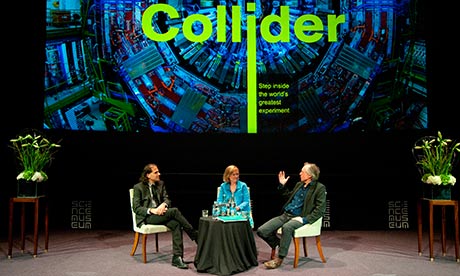
Nima Arkani-Hamed, Martha Kearney and Ian McEwan at London's Science Museum
Photograph: Jennie Hills/Science Museum


DO THE TWO CULTURES STILL EXIST?
IAN McEWAN: That old, two-culture matter is still with us, ever since [CP] Snow promulgated it back in the 50s. It still is possible to be a flourishing, public intellectual with absolutely no reference to science but it's happening less and less. And I think it's less a change of any decision in the culture at large, just a social reality pressing in on us. And it's true that climate change forces us to at least get a smattering of some idea of what it is to predict systems that have more than two or three variables and whether this is even possible. The internet has created sites like John Brockman's wonderful edge.org, where it's possible for laymen to sit in on conversations between scientists. And when scientists have to address each other out of their specialisms they have to speak plain English, they have to abandon their jargons, and we're the beneficiaries of that.
NIMA ARKANI-HAMED: It's an asymmetry that doesn't really need to exist. Certainly many scientists are very appreciative of the arts. The essential gulf is one of language and especially in theoretical physics, the basic difficulty is that most people don't understand our language of mathematics which we use to describe everything we know about the universe. And so while I'm capable of listening to and intensely enjoying a Beethoven sonata or an Ian McEwan novel it can be more difficult for people in the arts to have some appreciation for what we do. But at a deeper level there's a commonality between certain parts of the arts and certain parts of the sciences.

IM: I'm one of those know-nothing liberal arts students who at the age of 16 remembers a maths teacher coming into the room and saying "I'll take 10 of you volunteers and I'll get you through A-level maths" so us English, history, French types went and were patiently taken through and it was the most intellectually difficult and delightful thing I ever did. And the highest I got was calculus. I thought I had reached my intellectual ceiling. Now that's first steps for any maths undergraduate but it gave me a taste for the sort of respect for a society where you couldn't really claim to be any sort of intellectual unless you had some kind of foot in the world of mathematics. So I think we're in a situation of awkward respect. You go into Westminster Abbey and Dirac's equation is carved in stone. To stand there and look at it, I think even for those of us who've got very little grasp of maths, can be a kind of aesthetic experience.

NA-H: One of the things that we try to do sometimes in explaining what's going on in physics is to find useful analogies and metaphors. But we could be doing a better job explaining the structure in which we're having these thoughts, explaining why we're doing what we're doing, explaining the pursuit of truth with a capital T which is underlying all of it: what it is that motivates people to spend three decades working with not necessarily a payoff in sight until, every now and then, we celebrate these tremendous achievements. There is an obsessive element to it which should be familiar to the artist – to many people in society. And it's driven by the pursuit of something much, much bigger than ourselves and the little trivial concerns of everyday life.

SCIENCE, ART AND THE IDEA OF BEAUTY
NA-H:
There's a very common metaphor for describing the Higg's particle. It's this idea of the universe filled with something and the little ball bearing or whatever it was passing through the fluid picking up some inertia. That's a good example of a metaphor that gives some sense of what's actually going on. There's a difficulty with metaphors, which is that you can't take them too far – they're not literally what's going on. And often when that analogy is used there's some clever person in the audience, normally a 12-year-old kid, who puts up their hand and says "Excuse me, isn't that just like the ether? Didn't you guys learn anything?" And that's when we have to say: "Trust us. It's something that fills the universe that's not like the ether" and so there's always a limitation to metaphors. It is possible to explain some of these things. This is one of the wonderful things about fundamental physics. The essential ideas are simple. The possible answers to essential open questions are more complicated but the essential issues are deep and they're simple to state. And with some patience it's possible to address them head on and get a sense for what's going on without all the details of the mathematics. But it requires a very engaged audience and it can't be done casually.

IM: Nima has written a stunning essay for the layman called The Future of Fundamental Physics. There's not a line of maths in it. I'm not going to pretend it's easy reading but you wrote it, I think, for anyone who's interested in that question, outside the field. I think we've lived through a golden age of science writing. Natural selection is not a very difficult idea but its consequences cascade beautifully. Bayes' Theorem is not very difficult, I mean it's almost arithmetic and yet the applications it now has in neuroscience are formidable. So I think we can cross these fields together and I'm very interested in the aesthetics of this. There's that famous remark of Jim Watson's, when Rosalind Franklin came to look at his and Crick's model of a DNA molecule, that it was too beautiful not to be true. Again we come into this field in which the aesthetics of something in the Keatsian sense – beautiful and true – must embrace both subjects.

NA-H: We often talk of the idea of beauty in theories. And I think if this is interpreted loosely you won't get really a sense of what we mean. We have to be a little more specific. Ideas that we find beautiful are not a capricious aesthetic judgment. It's not fashion, it's not sociology. It's not something that you might find beautiful today but won't find beautiful 10 years from now. The things that we find beautiful today we suspect would be beautiful for all eternity. And the reason is, what we mean by beauty is really a shorthand for something else. The laws that we find describe nature somehow have a sense of inevitability about them. There are very few principles and there's no possible other way they could work once you understand them deeply enough. So that's what we mean when we say ideas are beautiful. A year ago I ran into this great lecture on YouTube by Leonard Bernstein about the first movement of Beethoven's Fifth. And Bernstein used precisely this language – not approximately this language – exactly this language of inevitability, perfect accordance to its internal logical structure and how difficult and tortuous it was for Beethoven to figure out. He used precisely the same language we use in mathematics and theoretical physics to describe our sense of aesthetics and beauty.

IM: You don't hear beauty much mentioned even by composers in relation to modern music. It's not the common pursuit. For my taste all atonal music sounds like an expression of anxiety. And yet I think we do need a return to this in the arts. I don't think we have much trouble in poetry with this. Seamus Heaney died recently and there was a lot of time to reflect on his work, and the beauty of those lines, of his work was constantly referenced. Part of the problem was modernism, the great aesthetic revolution of the early 20th century to which we are all bound and must work in gratitude for – but we lost certain things. Along the way emotion and art were somewhat detached. When I was a student at Sussex University we had to write essays on a statement by the Spanish philosopher Ortega y Gasset in which he said "tears and laughter are aesthetic frauds". This was the pure, high, modernist statement, that you had to detach those feelings about emotion and beauty from art itself.

THE DAILY LIVES OF ARTISTS AND SCIENTISTS
IM: I often wonder what theoretical physicists do all day and my fantasy is they are rather like novelists. They sit around with their feet on the radiator staring out the window with a notepad within reach. They must be in the world of that kind of misty, drifting, creative thinking that has a bit of talent, a bit of luck, a bit of being shaped by current mood that can bring sudden insight. To wonder how to progress or even start a novel is to enter a state of what V S Pritchett called determined stupor, and those of us who are paid to be in that state count ourselves very lucky.

NA-H: I've always thought composers and novelists are probably very close to mathematicians and theoretical physicists psychologically in how they go about things.

Perhaps contrary to a certain sort of mythology people don't go to their offices and just churn through equations. You have a certain set of questions you are trying to solve and you have to imagine what the story could possibly be for what the solution is. You have to try to imagine what the sort of global answer could possibly look like – or at least chunks of the global answer. You try on stories – could it work like that? And often because of the underlying rigidity, the same thing that gives rise to the beauty that we talked about, it's beauty because there is a right and wrong. There is some problem that's being solved. If the story is a great story it has a better chance of being right than if it's a crappy story. And sometimes stories are too good to be true and that happens very often. And we try out what could possibly be solutions to the problems and then we have to prove ourselves wrong as quickly as we possibly can. And that's what 99% of our life is about. We try out stories and we prove them wrong. So you have this experience of failing day after day after day and it's a particularly intensely bad feeling to fail so much because you know what success looks like and you can't fool yourself when you're not there. So even though you don't know what the solution is, you know when you don't have it. You have to keep going and going until gradually you fail better and better and better and every now and then, once every two or three years, something works.

IM: Here is a major difference. I'm well aware in science how important it is to be first. Being second with the structure of DNA would consign you to the dustbin of history, whereas every novelist knows that you're in a self-sustaining world in which whatever you say is so. It's for others to accept it or reject it. I often pity those scientists who are in a race just to get on the public record for the first time – days, weeks before someone else – and your life can be transformed. Crick and Watson are a perfect case of this. If [Linus] Pauling had got there before them we wouldn't have heard of Jim Watson. It's a tougher world.

NA-H: It's one of the classic things we talk about, the difference between art and science. Even here there's more commonality than meets the eye. But I want to say one thing about originality at an even baser level of how easy it is to be original, how much innate, intrinsic talent is needed to be able to do something. And here we [scientists] have an advantage – there's this thing out there that we're not inventing but discovering. And because of that all you have to do is get somewhere in the neighbourhood of the truth. You don't have to get particularly close to it, you just have to know that it's there and then you have to not fight it and just let it drag you in toward itself. If you're very talented you might hack your way there more quickly. If you're less talented you might have to pinball around and it takes a little longer to get there.

IM: That fateful morning when one of his children was extremely ill and Darwin opened a 20-page letter from [Alfred Russel] Wallace and said "All my originality is smashed". The anxiety attack that Darwin had then, no novelist could have such a thing.

NA-H: What you're talking about – the anxiety, who gets the credit and so on – this is important to the individuals involved. It's of no importance in the grand scheme of things. But there is an important sense in which even the same discoveries, even the same existing body of knowledge, the things that are sitting there in textbooks for hundreds of years already, are perceived in different ways by different scientists. Because to be able to do anything new you have to organise the existing body of knowledge in some unique way that's your way of thinking about it. One of the deeper reasons why it's important to have different people approaching the same problem – even if they end up finding the same solution – is the path towards a solution suggests many divergent ways things could progress and having many of those paths is still useful.

IM: Writing a novel takes roughly about the time of an undergraduate course for me and you might draw on the work of a historian, you might need to read a biography of a composer. I would like to feel that we could think about science as just one more aspect of organised human curiosity rather than as a special compartment. And it has, as has been very clear from this discussion, a powerful aesthetic. I think we need to generalise it. We need to absorb it into our sense that we can love the music of Beethoven without being composers and we could love science as a celebration of human ingenuity without being scientists.

Science has had a huge effect on my own sense of the world. It certainly has helped me along the way to a general global scepticism about religion. The world of faith is inimical to the world of science and in that sense science has helped me want to write books every now and then that celebrate a full-blooded rationalism. It's one of our delightful aspects and it informs what we try to do with our laws and social policy. We don't succeed a lot of the time. And we despair of human relationships at the most private level when they're irregular or contradictory. We demand even of our lovers a degree of coherence and behind that lies a notion of consistency and rationality. Enduring Love was actually a novel wishing to oppose the romantic notion that abstraction and logic and rationality and science in particular was a cold-hearted thing, a myth I think which began with Mary Shelley's Frankenstein. We need to reclaim our own sense of the full-bloodedness, the warmth of what's rational.

[EDITOR'S NOTE: Related reading on Edge: "The Third Culture", 1991]